2016 has been a strange year. A seemingly disproportionate number of musicians and actors have shuffled off this plane of existence. Sure, every year, people are born and people die. But to lose so many musical icons in the span of 365 days? It is hard to imagine though we've lived it, starting with the loss of David Bowie just two days after his 69th birthday in January.
In spite of all those tragedies, 2016 has at least given us several musical gifts to get us through the tough times. Below are my favorite albums of the year, though not necessarily in any sort of order of favoritism.
David Bowie - Blackstar
The genius of this album was apparent to me even when the lead, self-titled single had been the only thing released in late 2015. Embodying the spirit of Bowie in terms of unabashedly reinventing the rock icon, Blackstar was less about rock and roll and more about experimentation, a touch of jazz, many nods to the past, and a farewell that no one could have predicted (I felt he was saying goodbye by the end of the album, but more that this would be the last album and that he'd spend time with family and relax...not that he'd return to the stars so soon). Bowie is one of the few, maybe even the only one, who could turn their death into art. To this day, fans are still finding hidden Easter eggs in the Blackstar vinyl packaging with suggestions that there are many others that people have yet to uncover. It's painful to think this is the end, but I can't think of a more beautiful and touching parting gift from a truly unique artist to his fans. "There's a Starman waiting in the sky..."
Savages - Adore Life
I cannot sing the praises of Savages enough. Dubbed a post punk revival band, I scorn the label for it brings up images of bands like The Bravery, Franz Ferdinand, and Modest Mouse, which may have some musical nods back to the dark 80s genre, but are more influenced by it than anything else. Savages, on the other hand, dish out an English post punk formula that would have fit in perfectly alongside the likes of Joy Division, Siouxsie and the Banshees, and Bauhaus had they been making music in the early 80s as their predecessors were. Savages, to me, are the all-female version of Bauhaus - Jehnny Beth with the same sort of stage presence and theatrics as Peter Murphy, Ayse Hassan carrying the songs with a strong, gorgeous bass guitar turned deep lead, Fay Milton pushing each song along on the rhythm seat, and Gemma Thompson ripping out the same textural art guitar flourishes that Daniel Ash was so known for. Their second album, Adore Life, builds on the successes of their 2013 debut album while adding in a little more experimentation and, in places, slower and more reflective numbers, such as the album's title track. For the complete experience, be sure to catch these bad asses live - an incredible performance from start to finish full of so much raw energy it's unbelievable. It'll be a treat watching what they do next.
Peter Murphy - Wild Birds Live Tour
I've said it before and I'll say it again - it somehow isn't a year if I can't write something about Peter Murphy! In this case, Cleopatra finally gave life to an old House of Blues performance from the ($10 he's shuddering as I write this next bit) Godfather of Goth that took place in April 2000. While official video of that show has circulated YouTube for some time, and numerous bootlegs of the audio have circulated for even longer, Cleopatra finally decided now was the time to give it both a CD and double LP official release. Complete with Peter's interrupted "Indigo Eyes" (where his hand cramps up and he goes "I'm so gothic I'm dead!"), it's about time this show saw the light of day. Now if we could just get a live DVD of the video they took, we'd be golden...
Gary Numan - Here In The Black
It's been a very busy year for synth pioneer (arguably) Gary Numan. Numan has been crowd funding a new album via Pledge Music that brings fans along for the ride from the very beginning, something that is rarely done on Pledge Music (most bands run short campaigns to sell albums that are already finished...here, Numan is starting at the very beginning of writing and recording a new album, offering anecdotes from the studio and sharing rough demos periodically). The new year also brought his live show from the Hollywood Forever Cemetery during the Splinter tour to life. Released as a gorgeous set of picture disc records with an accompanying CD/DVD combo, you get a look at some of the recording of Splinter and most (but not all) of the performance from the Hollywood Forever. Despite some delays, the final product was gorgeous and masterfully done. Now to wait for that new album!
Iggy Pop - Post Pop Depression
The last few Iggy Pop albums have been lackluster at best, feeling like poor attempts to rekindle either the successes of the Stooges or of his early albums. Post Pop Depression, thought to be Pop's final album, is the strong note the proto-punk pioneer needed to go out on. Solid from start to finish, it's an album that doesn't try to hide the fact that Pop has gotten older. It embraces the change and evolution, drawing in enough from the past to pay its respects without trying to imitate or match it. The pairing with Queens of the Stone Age/Eagles of Death Metal member Josh Homme works perfectly, as each compliments the other and their two styles meld nicely. I hope this isn't the end of the music from Iggy Pop, but if it is, this was a damn fine album to go out on.
Nick Cave And The Bad Seeds - Skeleton Tree
How do you deal with grief, sorrow, and despair? Everyone handles these slightly differently and Nick Cave sought to explore those feelings and resolutions through the latest Bad Seeds album, Skeleton Tree. The album's theme, however, hit very close to home and very suddenly when Cave's young son died tragically. While most of the album was already completed prior to the accident, Cave went back and re-wrote portions to incorporate what he and his family were going through in the face of that loss. While it's hard to say how much of any one song relates to the incident, it's easy to feel the despair and heavy chested sorrow through the music. Taking a page from Leonard Cohen's book and crooning and speaking more than singing, this is an album that must be digested over time for its meaning to really hit home. Nick Cave and the Bad Seeds head out on tour early next year to support the album.
Leonard Cohen - You Want it Darker
Leonard Cohen has gone a long way from his hit classic "Hallelujah". Where his songs tended to be somewhat upbeat, You Want it Darker held true to its title, presenting darker themes, both lyrically and musically. Either from age and loss of his singing voice or to drive home the title's point even more, Cohen drops the singing in favor of somber spoken word, adding to the morose musical landscape. Deeply troubled by the passing of a long time friend, Marianne Ihlen, as well as numerous health issues within the last few years, Cohen wrote this album as a farewell of sorts, focusing on themes of death, religion, and the occasional bit of humor. Following interviews where Cohen claimed to be ready to die (then taking back what he said days later), 2016 passed cruel irony over Cohen with the 82 year old icon passing three weeks after his final album was released. We wanted it darker, and we definitely got it.
Mark Gemini Thwaite - Volumes
Though this gem probably won't be found on any major year end "best of" lists (though it should), former Mission/Peter Murphy/Gary Numan/Tricky/etc. guitarist Mark Gemini Thwaite ventured into a relatively unknown territory - a solo album. Not traditionally a singer, Thwaite opted to collaborate with several friends (and vocalists) to stitch together a debut album that highlights the diversity of Thwaite's playing abilities and musical interests. Though the numerous lead voices throughout the album may take some listeners a little more time to get used to, the album is solid in its music composition and vocal pairings. From the modern and brilliant ABBA cover of "Knowing Me, Knowing You" (featuring HIM's Ville Valo) to the infectious number "The Reaping" (with Ashton Nyte), Thwaite's solo album is catchy and makes a solid argument for why musicians should branch out into these kinds of projects more often. Currently touring with Ricky Warwick and the Fighting Hearts, we'll have to see what all MGT has in store for us in 2017.
Black Sugar Transmission - In The City's Arms
Speaking of other Peter Murphy guitarists, 2016 brought a glorious gift from Andee Blacksugar - a brand new double album. Pairing a bit of pop aesthetic to brilliant rock guitar solos, Black Sugar Transmission albums have always been a delightful mixing of experimentation with flair. In The City's Arms is a bit more experimental than his previous material, bringing in more industrial vibes ("Machinegun Sun"), heavier rock ("Puzzle"), and even a ballad here and there ("In The City's Arms"). A champion of self-produced music, Blacksugar proves you don't need a label or huge fancy recording studio to churn out quality music. You can pick up this work of art and his prior albums through his Bandcamp page.
Preoccupations - Preoccupations
When I first saw someone talk about Preoccupations earlier this year, they described it as a melding of Bauhaus and Joy Division. Obviously I had to check it out. Formerly known as Viet Cong, the electronic noise rock outfit's second album is solid. Though I'd say the sound is less a melding of Joy Division and Bauhaus and more of a melding between And One and Joy Division. To each their own, right? Regardless, Preoccupations along with the likes of Savages give hope for the future of dark art rock.
What albums did I miss? What are your favorites from this year? Let us know in the comments!
London post-punk "revival" (so quoted because they sound and feel more like an original 80s UK post-punk group than the 2000s revivalist groups in the vein of Franz Ferdinand and the like) Savages have returned with a new album, Adore Life. The album follows on the heels of their very successful debut album, 2013's Silence Yourself.
Savages have released their second album, Adore Life
Silence Yourself carried a very traditional post-punk sound and aesthetic, drawing heavy influence from groups like Siouxsie and the Banshees and Joy Division. While a strong album, it was a bit light in the experimental nature that surrounded the original 80s post-punk genre. Adore Life brings that experimental nature to the forefront, resulting in a dynamic album that effortlessly navigates faster, traditional post-punk tunes through slower, ballad-like numbers, all without losing the listener or leading to the often ill-fated "never-ending-album-will-someone-please-turn-it-off" syndrome that over-experimentation can cause.
Adore Life opens with "The Answer," a distortion-laden song revolving around love and adoration. The song presents a larger focus with a driving bass line supplied by Ayse Hassan and a guitar solo from Gemma Thompson. The frantic guitar throughout the song strongly parallels singer Jehnny Beth's vocals with lines like "I'll go insane / Please stand up / What is the point?" which detail some of the struggle in determining how someone feels about you.
"Evil" starts off with an interplay between Hassan and Thompson that sounds vaguely similar to Killing Joke's "New Cold War" from Pylon (2015), though minus the heavy distortion industrial-leaning sound. Fay Milton on drums rounds out this number, providing a solid background with minor layers of detail that enriches the song further.
What makes Savages, in my opinion, more like the original post-punk bands and less like the modern "revival" post-punk bands is how many of the songs are highly bass-driven. "Evil" is just one example with "Sad Person" being another. Bands like Bauhaus and Joy Division are largely loved on a music level due to this somewhat unique quality, where the bass and drums provide much of the meat and drive of a song with guitar adding little flourishes here and there.
The album's title track opts for a slower, more reflective tone, led largely by Hassan on bass. Beth's lyrics center around a question of humanity and whether the idea of adoring/valuing life is unique to people and contemplates on past actions and whether it was best to do those, even if they led to negative endings, resolving that even if you have regrets, you lived life, you adore life because you continue on.
Adore Life continues in much the same manner as the early songs, offering driving music matched to Beth's Siouxsie Sioux-esque vocals. Songs like "When In Love" and "Surrender" deserve additional praise, the first for one of Thompson's opportunities to shine on guitar, and the latter for a very synth-layered bass backing from Hassan that nods back to 80s new wave meets darkwave sentiments.
Savages are set to tour this spring in support of the new album, reaching Dallas on April 11, playing at Trees. With two strong albums under their belt, and perhaps the only band to play an amazing show at 8am on a Tuesday morning, this is not a show to miss. Tickets are on sale now and can be purchased here.
Today's Music Review will be of Peter Murphy's tenth album (ninth studio), 2014's Lion.
Cover art for Lion
If there is one thing to expect about the "Godfather of Goth," it is to expect the unexpected. Over more recent years, Peter Murphy's career has gone places few would expect - starting perhaps with a turn of the century reinvention that spurred 2002's unique masterpiece, Dust, followed by 2004's return to pop rock form that Murphy had previously built his career on, Unshattered, and ending most recently with 2011's rock triumph full of attitude and energy, Ninth.
Lion, produced by Youth (Killing Joke), is everything you would expect from Murphy at this point and still so much more than you could have guessed. With most of the tracks originally written and recorded on the spot in the studio and in the span of only a handful of days, the album flourishes with an immediacy that makes Ninth feel tame in comparison. Richly sprinkled along the slew of single-worthy anthemic songs are compassionate, emotional ballads that still show off Murphy's rich vocal prowess and beautiful lyrics.
The album opens with the first single, "Hang Up," a synth-heavy song laced with screaming vocals that have been atypical of Murphy's career so far. Afterwards, the album winds into the electro-dance song "I Am My Own Name," which may be Murphy's response to much of the criticism he received in 2013 for endeavoring to do a full Bauhaus tour around the world without the other three original members of the band.
Amid the instantly dance-able songs come slower, passionate pieces that are a bit more reminiscent of Murphy's earlier works, including "Compression," "The Rose," and the soaring "Loctaine." Perhaps a nod back to Murphy's roots in the 80s music scene, songs like "Holy Clown" and "Low Tar Stars" carry the feeling of an 80s new wave song created for the dispossessed (the latter in particular sounding like the dark version of Michael Sembello's 1983 hit song "Maniac").
Lion rounds out with other notable songs "I'm On Your Side" and "The Ghost of Shokan Lake." "Eliza" is a slight change of pace for Murphy, not focusing so much on forms of love, introspection, and religious ideologies, but instead on the idea of leaving self-blame behind, being yourself, and celebrating life.
Murphy's tenth album ends with the title track "Lion," which has a lofty, atmospheric background music to fill in around Murphy's lush, deep vocals, creating a song that alludes to some of the many qualities of an actual lion - powerful, majestic, and encompassing. While not a fast, hard hitting song to round out the album in a fashion of how it started, "Lion" leaves the listener with a feeling of completing a musical journey guided by Murphy through introspection, religion, history, and even a glimpse into the future.
Lion is the rock-dominated album many would expect of him following Ninth. Given his desire on the previous album to prove a point of existence and importance, Ninth was in some regards the album Bauhaus never made, serving to assert Murphy's place as a solo musician and a rock star. Lion is the vastly more experimental follow-up to Ninth now that the audience and self-imposed (to some extent, at least) expectations of the former Bauhaus-frontman are squashed. What comes next only Murphy knows, but Lion may well be one of the best works he has done to date, combining much of what he was originally loved for during the Bauhaus years, the complex lyric writing that has persisted throughout his solo career, and an ingenious musical progression that is neither forced nor completely alien to long time fans. This album will certainly be on repeat for a long time to come.
Peter Murphy will be joined by current band members Emilio "Zef Noise" China (bass guitar, violin), Andee Blacksugar (guitar), and Nick Lucero (drums) for a tour of North America to support Lion that begins June 9, 2014 in New York. Peter Murphy visits Austin at The Belmont on July 29th with local favorites My Jerusalem providing opening support once again (they opened for him on last year's Mr. Moonlight Tour).
It's been ages folks, but we're back with more music and show reviews for your reading pleasure. A little late to the bandwagon, surely, but as a welcome back to everyone, today's Music Review will be on Peter Murphy's second single off of Lion, "I Am My Own Name."
Peter Murphy, 2014.
Murphy approaches Lion from an interesting standpoint - it will be his tenth album (ninth studio), the follow-up to his successful rock monster Ninth (his prior work has categorically fit under pop rock where Ninth became his first solo album to firmly grasp the rock field and take it by force), and an album born mostly during a time where the singer revisited the vast catalog of his original band, British post-punk act Bauhaus.
"I Am My Own Name" is a healthy dose of everything you expected given the above (a very gutsy, complicated mesh of emotion and freedom), and yet Murphy surprises the listener by throwing in something utterly new and foreign - synthesizers in a Numan meets Reznor-esque produced dance track for the dispossessed.
The song opens with moody electric violin work from current bass guitarist and violinist, Emilio "Zef Noise" China. In a style that classically eludes to the Middle East (which Murphy, who has called Turkey home for the last roughly 20 years, has done on nearly every album, both subtly and dramatically), this soft introduction begs the question of "What is he doing? What does Murphy got up his sleeve?"
The vocals then kick in, smooth at first, but then with an edge, a harsh scream as Murphy declares that he is "[his] own name." The song then gains in tempo, guitars and drums starting as Murphy tells his story of who he is and is not, merely to say that he is his own name, for what that may or may not mean.
"I Am My Own Name" lyrically appears to focus on some of the recent naysayers who have criticized Muphy both professionally and personally. Some such lyrics include at the beginning "No thin Pixie/white and drawn/no shaded shadow...no jaded shock star..." (Apologies for any errors in the lyrics as they've not been published and this is a best guess) The first part about not being a pixie could be a reference back to the Bauhaus song "Crowds" which has the line "A slim Pixie, thin and forlorn," suggesting that he may not be so innocent and gullible, in a sense, as he was when younger and also not depressed as many have been led to think (also in line with the upbeat tone of the music). "No shaded shadow" to perhaps mean he is no longer going to "hide in the shadows" and not do certain things because it is frowned upon, and not a jaded shock star as there is more value in his work than just going for the easy shock that many stars today try for.
Whether these interpretations hold any merit is, of course, unclear. However, Murphy takes us down an interesting journey with this song, proving once more that he can do something incredibly different, yet still make it his own without alienating the listener. One thing is for certain with this song - if it is performed live and no one is moved by it, either physically or emotionally, nothing will move them.
Lion, produced by Killing Joke's Youth, roars to life June 3rd. Murphy kicks off his North American tour to support Lion June 9th in New York and will visit Austin July 29th at The Belmont (regular and VIP tickets on sale now). Finally, Murphy is in the middle of a Pledge Music campaign to fund the release of a live DVD from the Mr. Moonlight Tour. Check it out here and support today!
Today's Music Review is of the newest offering from industrial rock outfit Nine Inch Nails, 2013's Hesitation Marks.
Album cover for Hesitation Marks
Nine Inch Nails originally formed in 1988 in Cleveland, Ohio, by frontman and only consistent member of the outfit Trent Reznor. Since the group's conception, Reznor has maintained sole responsibility for the band's direction, writing the majority of the music and lyrics, playing most instruments for recordings, and being a main producer of each album itself. The first album, 1989's Pretty Hate Machine, did not fair too well on record charts but in time became one of the first independently released albums to achieve platinum certification (meaning over 1,000,000 copies have been sold of the album since its release). In 1990, Nine Inch Nails began touring and opening for acts like The Jesus and Mary Chain and Peter Murphy (who would go on to become good friends with Reznor and collaborate with him on covers of both Bauhaus and Nine Inch Nails material).
Trent Reznor (left) and Peter Murphy (right), probably around 2006 when Bauhaus was opening for Nine Inch Nails. Photo from Last.fm
Following touring to support the debut album, pressure mounted on Reznor to produce a follow-up album. However, Reznor was having a hard time coming to terms with the label Nine Inch Nails was on at the time, wanting the band's contract to be terminated. Ultimately, Nine Inch Nails was allowed to switch to a different label, but all new material Reznor had been working on had to be recorded under various pseudonyms to avoid the original label from confiscating the material. In the end, the material recorded in this shaky period was released as 1992's EP, Broken.
Broken, despite being only an EP with six songs, was a major success for the group. The album charted in the top 10 and won the group two Grammy awards (one for a live performance of "Happiness in Slavery" from Woodstock 1994 and the second for the album's second single, "Wish"). Despite the successes of Broken and some reworked material on the follow-up EP (released later in 1992, Fixed), Reznor did not take Nine Inch Nails on tour for this material. Instead, he holed up and began writing new material for the next full length album.
1994 saw the release of what many regard as the best Nine Inch Nails album, The Downward Spiral. The album debuted at number 2 on the charts and remains the highest selling album of the band's tenure, having sold more than five million copies worldwide since its release. Despite the album's overwhelming success, none of its singles fared well, with "Closer" being the highest ranking at a rather mediocre 41 on Billboard's Hot 100 chart (the video is below, but be warned, even the director's cut version can be offensive to some people). The album does include the more introspective and, comparably to the rest of the album, mellow "Hurt" which has gone on to be covered by a slew of musicians, including Johnny Cash and Peter Murphy.
It would be five years until the next Nine Inch Nails release, 1999's double album The Fragile. The album garnered much media attention in the year leading up to its release and debuted at number one on the charts. Despite the high debut and media frenzy leading up to its release, the album received mixed reviews and fell out of the charts over the next week, at the time setting a record for dropping from number one to nothing the fastest (a record that has since been broken). Subsequent touring to support the album was funded purely by Reznor. Various remixes of songs from the album would be released over the next year, mostly to poor reviews.
2005 saw the release of the next big album for Nine Inch Nails, With Teeth. The album also debuted at number one on Billboard's charts. Most reviews were positive for the album, praising it as a return to the original Nine Inch Nails sound. Some reviews knocked it, feeling Reznor had run out of ideas and was repeating what he had done before in an effort to just make some money. All three singles from the album ("The Hand That Feeds," Only," and "Every Day is Exactly the Same") would top Billboard's Alternative Songs chart. To wrap up touring for the album, Nine Inch Nails performed at several festivals and amphitheaters in 2006, notably with one of Reznor's major influencing bands, Bauhaus, as openers (and as a fun factoid, this stint of touring would be the last for Bauhaus before their final split).
2007 saw the release of Year Zero, an album that marked a change in the slow release schedule of the prior albums and one that was a concept album aiming to criticize the United States government and policies in place at the time and what their effect would be in the next fifteen years. Overall, the album received largely positive reviews and would spurn a remixed version of the album. The remixed album would fulfill the contractual obligations of the band to Interscope Records, a contract that would not be renewed.
In 2008, messages on Reznor's website appeared and simply stated "2 weeks." There was some speculation of a new album, but the thought of a new album seemed equally silly as Year Zero had just been released. In March 2008, however, two weeks after the message appeared, Ghosts I-IV was released, a 36 track instrumental saga that could be downloaded for free (in part) or purchased on various media formats. The album is licensed under Creative Commons Attribution Non-Commercial Share Alike (basically, people can freely share this album as long as they don't look to make profit from it). A similar "2 weeks!" message appeared on Reznor's website in April, and true to form, two weeks later in May 2008, the double album The Slip was made available as a free download (under the same Creative Commons license as Ghosts I-IV) and later released as a limited edition CD of 250,000 copies.
2009 marked the Wave Goodbye Tour, which was promoted as the farewell tour for the band. The group performed several of their hits from the previous albums and only played minimally off the more recent albums. Following what seemed to be the end of Nine Inch Nails, Reznor went on to form the band How to Destroy Angels with newly married wife Mariqueen Maandig and longtime collaborator Atticus Ross. The group has since released one EP and one full length album. Reznor and Ross would also go on to produce soundtracks to a few movies, notably "The Social Network" and "The Girl With the Dragon Tattoo."
February 2013 marked the official return of Nine Inch Nails with the revealing of a new album to be released later in the year and confirmed touring to support the new album. Throughout the summer of 2013, three singles from the upcoming album were released with the first single, "Came Back Haunted," given a music video directed by the infamous David Lynch (see my review of the first single here: Click Here!)
September 3, 2013, marks the release of the first new Nine Inch nails album in roughly five years - Hesitation Marks. The album title, referring darkly to the first cuts one makes in attempting suicide, sets the tone for what may be one of Reznor's strongest albums yet, combining the musical exploration and textures prevalent on The Fragile with a dash of experimental ambiance found on The Ghosts I-IV with much of the anger and emotion coming through in parts of Pretty Hate Machine and The Downward Spiral. Lost on this album is much of the commercial feel recent albums like With Teeth and Year Zero contained (and especially loses the overproduction feel that both Year Zero and The Slip often had), instead opting for a more exposed look and feel that may even hint at some of Reznor's past personal problems with alcohol abuse.
The album evokes feelings of losing oneself and feeling like you have reached the lowest point without any means of escaping it (as felt in "Find My Way," an emotional slower tune), and feelings of trying to move on but being incapable of doing so (such as in "Came Back Haunted" which may refer to Reznor's attempt to leave Nine Inch Nails behind to work on other things, but inevitably being haunted by a desire to work more in this vein and continue on). Half way through the album is the catchy tune "Everything" which serves as a transformative moment on the album (with the first half focusing on the darkness and feelings of loss and hopelessness and the second half focusing more on finding a way out of that darkness and surviving). The album closes on the dark, brooding instrumental piece "Black Noise," which may suggest that no matter how you try to escape your troubles, they will always be looming around the corner, waiting. There is no escape, only survival.
Some notable tracks to listen to include "Copy of A" (which features a rather unexpected contribution with Fleetwood Mac vocalist Lindsey Buckingham), the first single "Came Back Haunted" which proves to be chilling in its own right, the transformation rock hit "Everything," the edgy and pressing "Running," the brooding and expressive "I Would for You," and of course the final note of the album in its dark glory, "Black Noise."
Compared to the rest of the Nine Inch Nails catalog, Hesitation Marks may not be as good as Pretty Hate Machine or The Downward Spiral. The album however is perhaps one of the best Reznor has made since The Fragile, combining glimpses of Reznor's personal struggles, his methodical composing, enough experimentation to be unique yet not alienating, and enough of an emotional experience to hold up with the best albums from Nine Inch Nails. It is an album that has evolved greatly from the early Nine Inch Nails albums, but I think after a few listens, if you open your mind to the music and understand how a musician can evolve over almost twenty-five years, you start to see where this album is still the same edgy Nine Inch Nails they were back in the early 90s and how they have also become a more calculating and at times introspective brooding entity that slowly washes over you. If you're a long time Nine Inch Nails fan, this album is sure to please. And if you're new to the band, this is one great album to get you started on their full body of work. Be sure to catch Nine Inch Nails on their upcoming Tension 2013 tour (I know I will when they play San Antonio in November).
Today's Music Review will cheat a tiny bit and be of not one, but two, offerings from the short-lived collaboration of Peter Murphy and Mick Karn - Dalis Car.
Dalis Car in 1984 - Peter Murphy (vocals) on the left and Mick Karn (bass guitar, saxophone, synth, flute) on the right
1982 was a tumultuous year for both members of Dalis Car. For Peter Murphy, it was the sign of the end of Bauhaus coming. October saw the release of The Sky's Gone Out, a decidedly dark offering from the British rockers that was met with mixed reviews leaning more to the negative side of the scale than positive. Among the four members, there was growing tension about the direction in which to take the band. As tensions mounted, the group toured in early 1983 before settling down to record their fourth studio album. It was during this time that Peter Murphy fell ill with pneumonia, spending time in the hospital and unable to record. The remaining members of Bauhaus decided to go forward without Murphy, writing and recording most of the album before he was well enough to come to the recording sessions. This, combined with unease over Murphy being given more of a spotlight by the press (with a semi solo appearance in the opening scenes of The Hunger and appearances in a string of Maxell ads not helping matters any) resulted in the band disbanding shortly after recording for Burning From the Inside had been finished.
Bauhaus in 1982 before the group split. Left to right - Peter Murphy (vocals), David J (bass guitar), Daniel Ash (guitar, saxophone), Kevin Haskins (drums). Image from Ondarock's website
Similarly, Japan's rise to fame was also becoming characterized by immense personality clashes among the members of the group and eventually deep personal clashes (notably between Mick Karn and David Sylvian). 1982 marked the release of Tin Drum which would be the final Japan album. The album resulted in one of the group's most popular songs, "Ghosts," which reached number 5 on the UK pop charts. The group went on a farewell tour following Tin Drum's release. Most of the members of Japan went on to other projects and solo careers of their own.
Japan. Right to left - Mick Karn (bass guitar), Steve Jansen (drums), David Sylvian (guitar, vocals), Rob Dean (guitar), and Richard Barbieri (keyboards). Image from Japan's Last.fm artist page.
How Peter Murphy and Mick Karn met is a bit of a legend and depends on whose story you wish to follow. Musically, Japan and Bauhaus are not very similar (yes, both rose from the ashes of the punk movement, but Japan was more in the New Wave/New Romantic vein while Bauhaus remained more in the post-punk and media-dubbed "Goth Rock" arena). Per Karn's version, his agent had heard of Bauhaus splitting and saw Peter Murphy as the yang to Karn's yin. Where Karn was not known for being a lyricist and vocalist, Murphy was not know as a musician in the purest sense. His agent suggested the two work together, Karn agreed they try it out, and the two parties came in contact. Per Murphy's version, he was conducting a post-Bauhaus interview and was asked who he'd collaborate with if he could work with anyone. Not thinking anything of it, he said Karn's name as he was drawn to Karn's musical genius. Days later, Murphy came home to a message on his answering machine - from Karn himself proposing they start a new project together!
Perhaps even more mythical is how the duo came to call the new project 'Dalis Car'. One prevailing theory that has been denied by Murphy and Karn attributes the name to a Captain Beefheart song (the song being titled "Dali's Car" from his 1969 album Trout Mask Replica). Another theory centers around an art exhibit in the late 1930s that featured a piece by surrealist painter Salvador Dali (dubbed 'Dali's car'). The final prevailing theory revolves around a dream Murphy had one night of being offered to buy a car from Salvador Dali that would grant a "mystical" experience. Regardless of the true series of events, Karn and Murphy agreed to begin a new project in 1984 and opted to name it Dalis Car.
Things were difficult for the two from the get go. Both preferred to work alone on the songs, sending tapes back and forth through the mail as opposed to working together in the studio. This eventually resulted in their first release, 1984's The Waking Hour (with "The Judgement is the Mirror" released as the only single from the album) before the two split to each embark on their own solo careers. Part of what prompted the split stemmed from the difficult writing conditions and how each wanted to dominate the project (since both had seen success in their respective pre-Dalis Car endeavors). Additionally, reviews of the debut album were far from flattering, pointing out that the album was a literal mashup of the duo's strengths with nothing additional from outside the box. While Dalis Car was not nearly as popular and successful as one would think, it did result in something rather positive for Peter Murphy.
Most of the music and lyrics of Bauhaus were not written by Peter Murphy at all. It wasn't until The Sky's Gone Out that Peter Murphy wrote and composed a few songs on his own (particularly "All We Ever Wanted Was Everything" where he wrote the music surrounding some of the first guitar chords he learned to play while Daniel Ash supplemented the lyrics and "The Three Shadows, Pt. II" where Murphy composed all the music). Post-Bauhaus, there was some doubt as to whether Murphy could pull off a solo career. Did he have the experience? Did he have the musicality? Many skeptics thought not. With Dalis Car, Murphy had more free range in writing the music and the lyrics, proving that he could do this on his own. With Dalis Car dissolved in 1985, Peter Murphy went on to start his solo career, releasing his first album in 1986 (Should the World Fail to Fall Apart). His writing style would initially require a muse through which to convey his thoughts and turn them into actual notes, but the unique method would pay off handsomely with a very loyal fan base and near mainstream success with his third album, Deep.
Still going strong, Peter Murphy. From the May 7, 2013 show on the Mr. Moonlight Tour at Webster Hall in New York City. Photo from The Bowery Presents website.
Over the years since Dalis Car first met, Peter Murphy went on to release eight studio albums and even tried to reunite Bauhaus twice, first in 1998 on the Resurrection Tour (which was to hopefully result in a new studio album, but those plans were cut short as the group quickly disbanded again after the tour) and again in 2005/2006 to tour mostly as openers for Nine Inch Nails (2008 did see the fifth and final Bauhaus album, Go Away White, released, but no touring would take place to support the album as the album itself was barely finished due to more struggles among the members of the group). Mick Karn, on the other hand, went on to release numerous solo albums, collaborated with several musicians, and write a book about his life up to 2006, intending to write another book about his life in time.
By this point, Dalis Car was as dead as Bela Lugosi. No one had really given the short-lived project any thought. 2010 came rolling around, 26 years after Dalis Car had formed and disbanded. In June, Mick Karn announced on his website that he had been diagnosed with terminal cancer (the type was never revealed). His family was struggling financially with the medical costs and they sought help from his fans. Many helped and several tribute concerts were staged to help raise money for the ailing Karn. For fans, this was the worst news they could ever receive. Mick Karn, talented musician, integral part of Japan, master of his own solo work, was dying at the young age of 51.
A more recent picture of Mick Karn. Photo from thegoldenyear.wordpress.com
Unexpectedly, in August of that same year, Peter Murphy posted a video to his Facebook account (which was quickly removed/hidden) where he disclosed to fans that he was teaming up with Karn again to revive Dalis Car one more time and that the two would begin working as early as September. It was the first time the two would see each other since 1985 (link).
While the two planned to record a full length album, Karn's health fell dramatically and quickly. Karn lost his battle to cancer on January 4, 2011, at the age of 52. Only five tracks were finished, released in April 2012 as the EP InGladAloneness. The original Japanese release included a book with photos taken by Steve Jansen (Japan's drummer and who remained friends and collaborators with Karn over the years) and comments from artists who had worked with Karn on his legacy and life. On July 24, 2013, what would have been Mick Karn's 55th birthday, InGladAloneness was made available for purchase again with 100 copies signed specially by Peter Murphy with all proceeds going to the Mick Karn Appeal Charity to help his family.
Cover to 1984's The Waking Hour
The Waking Hour is incredibly characteristic of both Murphy and Karn. The bass licks Karn recorded are unmistakable signatures of his style. Vocally, Murphy sounds much as he did while in Bauhaus, complete with beautiful, cryptic lyrics. Different for Murphy, however, is the style of the music, featuring a slew of other instruments aside from the drums and bass guitar that were heavy players in Bauhaus's music with guitars used mainly to add texture to songs. Also lacking on the album were the screams and shouts Murphy tended to cast in later Bauhaus recordings. On a certain level, Dalis Car was what one might expect - a sum of its parts.
The second track, "His Box," features a Middle East-influenced synth part that makes this track stand out. A gorgeous track, Murphy does wonders in creating the harmonies on vocals. The bass guitar is characteristic of Karn, yet inviting. Flutes and guitars add rich flourishes to this song. Personally, I think this one would have made a fine single as well had the album been viewed a bit more favorably and if Karn and Murphy would have continued further on this project.
"The Judgement is the Mirror" is the only single from the album, characterized with dominating synth and bass guitar to Murphy's smooth vocals. Drums don't feature very prominently on this track. This one serves as a beautiful ending to the album. The music video features both Karn and Murphy dressed in full suits passing off a laserdisc in a manner that nods back to them being the yin to the other's yang.
Other stand out tracks include the synth dominated "Cornwall Stone," the self-titled "Dalis Car," and absolutely stunning musical "Artemis" (which receives a "face lift" on InGladAloneness with some updated instrumentation and lyrics). In all, there honestly isn't a bad track on this album and while it may have elements highly characteristic of both musicians, I don't see why that should be considered a bad thing.
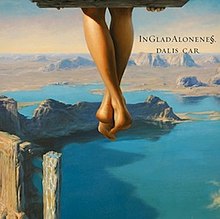
Cover to 2012's InGladAloneness EP
InGladAloneness can be described very succinctly - it is chilling. On the one hand, it amazes me how nothing seems to have changed in the 26 years between this EP and The Waking Hour. Playing the two back to back, you cannot tell that kind of time elapsed. Murphy is vocally spot on and Karn's style is just as glorious as ever, perhaps made slightly better with the passing of time. The composition of each song is true to form with The Waking Hour and the lyrics just as beautiful. The EP brings in a bit more Middle East influence, particularly with the track "Subhanallah" (which, oddly enough, is not a Dalis Car track originally).
There is something absolutely divine to this EP. It feels as if Karn knew this would be his last work. There is so much soul and emotion with every song. "Subhanallah" (translating to "God is Great" from Arabic) is a bit haunting to me. It is a dua (invocation/supplication that is part of Islamic prayer where a Muslim aims to connect with God and ask for forgiveness and favors) that is written in Turkish. While this song was not done originally by Dalis Car (Murphy recorded this somewhere around the turn of the century as it was included on the small issue of VHS tapes of The Grid), it may have been included as a parting prayer of sorts from Murphy to Karn.
The EP ends with "If You Go Away," a peaceful and soft song marked with a backing orchestra arrangement and acoustic guitar to Peter Murphy's soothing vocals. The track is a cover of the popular Jacques Brel song "Ne me quitte pas", which is said to have been one of Karn's absolute favorite songs. The song is a powerful closer to the EP in its softness, presenting a rather emotional end that stands in contrast to the other four tracks on the EP. It is a touching and emotional farewell.
Overall, I hold that this is easily the most underrated and underappreciated of all the post-Bauhaus projects. It holds a surreal uniqueness that is still true to form for both Karn and Murphy. Even more astonishing is how the two could pick up where they left things 26 years later and record a last effort on Karn's part that is beautiful, chilling, and lasting. My only qualm with this project is that there simply isn't more. Rest in peace, Mick.
Today marks a special Music Review (and needed a somewhat witty title that tells you nothing unless you already know). I bring you a fairly rare treat - a review of the 7" collaboration between Rene Halkett and David J, "Nothing"/"Armour."
Album art to "Nothing"/"Armour" featuring original artwork by Rene Halkett himself.
I've titled this post "Bauhaus Meets Bauhaus" because, well...that's what this literally is. Rene Halkett was, from 1923 to 1925, a student of the original Bauhaus school in Weimar, Germany (the original school was open from 1919 to 1925 before moving to Dessau from 1925 to 1932, and then finally moving to Berlin from 1932 to 1933 before closing for good due to pressure from the Nazi regime). The Bauhaus art form is heavily marked by lack of ornamentation and focuses on meshing function of the object or building to its design. The art form also incorporates modernism, leading to rather simple designs, the favored ability of mass production and industrialization, and an overall clean look. While at the famous art school, Halkett worked on his painting and writing talents. After leaving the school in 1925, he became a bit of a newspaper journalist writing for a local liberal print. Once the Nazis took power in Germany, Halkett left the country for England where he became involved at a children's theater as a painter. Halkett would later serve as a translator during the Nuremberg Trails and eventually found himself working the German section for the BBC.
As many of you perhaps know from my prior postings, David J was the legendary bass guitarist for British post-punk group, Bauhaus (originally named Bauhaus 1919, and going so far as to even use the same typeface logo as the art school once had). Since those days, he has gone on to be part of another legendary post-punk act (now more or less defunct), Love and Rockets, and has maintained a fairly constant slew of solo recordings over the years with some touring here and there, recently with opening and backing band Adrian H and the Wounds. He has also been part of several collaborations including (but surely not limited to) appearing on some releases by Porno For Pyros, having done the bass work on Voltaire's 2011 album (Riding a Black Unicorn Down the Side of an Erupting Volcano While Drinking from a Chalice Filled with the Laughter of Small Children), and contributing bass to a track for Amanda Palmer and the Grand Theft Orchestra. As of this writing, David J has released eight solo albums, contributed (maybe even did all the work? I'm not sure) for four film scores, and five EPs on his own.
The indelible Mr. David J. Image from the LA Stage Times.
So, Bauhaus meets Bauhaus, indeed!
I don't know much of the story about how this little project came to be. What little I've unearthed suggests that somehow David J knew of Rene Halkett and where he lived (the back of the 7" sleeve lists Halkett as having been a lecturer and BBC-broadcaster, among other things, so maybe David J saw him on TV or attended a lecture of Halkett's when attending art school?). In 1980, David J (still very much part of Bauhaus the band, which dissolved for the first time in 1983) drove to Halkett's cottage with a tape recorder and the intention of recording Halkett reciting some of his poetry. Later on, David J added music to the background of these recitations and the initial product released was this 7" in 1981. Years later, the two tracks on the 7", an additional track that was much longer, and the original recordings of Halkett speaking only were released as a very limited press CD (about 1000 copies total). The collaboration was rather fortuitous in timing as Halkett passed away in 1983, only a couple years after the two met and recorded the initial recitations. Purportedly, David J inherited a lute from Halkett and used it to make some of the backing music.
For the purpose of this review, I will look at only the two original tracks on the 7".
"Armour" opens with just Rene Halkett reciting his poetry before (and rather abruptly) piano, drums, and bass enter the fray. Everything musically is fairly signature of David J (keep in mind that Bauhaus musically was typically very drum and bass heavy which is relatively unique and rather refreshing at times, and David J clearly brought that mindset forth to this collaboration). The recitation itself is absolutely sublime. Rene Halkett's voice is strong even in his old age and his accent adds a dark touch to the poem. The recording has a slight echo to it, as if recorded in an empty room. The poetry itself is beautiful and a dark delight to behold.
"Nothing" opens with Halkett and some background music (which at the very very beginning sounds like a small portion of the music from "Hollow Hills" was used? The part towards the end before the lyrics basically repeat "So sad...hollow hills...so sad..."). This track is perhaps even more chilling than "Armour." As before, Halkett's voice is clear and David J does a superb job of meshing the music to the poetry (as an example, at one point early in the track, Halkett recites "As if I could remember it, I'd tell - there was that light" and immediately after he says "light" a loud crash sounds).
Ultimately, this is a truly unique and dark collaboration between Halkett and J. How it came to be, I am unsure, but I'm so very glad it did. Rene Halkett shows his skill as a poet and the manner in which he recites his work is chilling. David J does a grand job providing the background music to enhance the recitations and add another level of feeling and emotion to the poems. The only tragedy in this piece of work is that it was only (originally) the two poems (and even with the addition of the third poem on the limited edition CD, it still isn't enough). This is a rare treat everyone needs to listen to.
Let me begin by saying this may be the only time I ever do a TV series review, which goes to show how much I felt moved to write a review about this series.
As some of you may know, The Hunger is one of my favorite films. I don't believe I have ventured to review it yet, but what isn't there to love about that film? It has "Bela Lugosi's Dead." It has Bauhaus. It has Peter Murphy (in a cage, no less). It has David Bowie. Catherine Deneuve. Susan Sarandon. Gorgeous classical music. Deliciously creepy sounds. A gorgeous apartment home. Vampires. What more do you want!?! The only tragedies surrounding the movie are: 1) Needs more Bauhaus, 2) Seeing David Bowie age rapidly makes the heart cry, 3) The official soundtrack for whatever reason actually does NOT feature "Bela Lugosi's Dead" (seriously, why not? Come on!), 4) I cannot get the book to save my life ($30 or so is a bit much), and 5) Finding a movie poster for a decent price is also near impossible. But otherwise, one could not ask for more.
David Bowie and Catherine Deneuve scope out the club looking for their victims for the night.
So, imagine my delight upon finding a TV series by the same name that had some similarities and ties to the movie! Also imagine my confusion when I saw the series was only moderately rated (averaging about a 3 out of 5). But, okay, fine. I love this kind of stuff where others don't typically. Remember my 5 out of 5 rating for The Sky's Gone Out from Bauhaus? "Official" reviewers give it a 3 or 4 out of 5. I like my pasta and I like it creepy.
There are only two seasons of the show. Each episode runs in a similar fashion where The Host (played by Terence Stamp in season 1 and David Bowie [yes, DAVID BOWIE!] in season 2) introduces the episode by saying something snarky and/or witty. The episode then plays which typically explores some dark facet of human nature, be that the excesses of sexual desire, people with odd "talents," vampires, etc. There really aren't any happy ends and usually the main character meets some unfortunate demise. The episode ends with The Host again saying something witty to try and close things and "teach you a lesson." Basically, this has the feel of Tales From The Crypt, but I don't feel the series ultimately captured the same kind of magic, if you will, that Tales From The Crypt had.
A rather dapper Terence Stamp, much as he looks when portraying The Host
What I've found in watching the series (which is available in full on Netflix, for those interested) is that some episodes are well done while others are terrible. None of the episodes share characters, so it's easy enough to skip over ones you don't like, which is nice.
WARNING: Some spoilers are found below as I recap a few episodes. You have been warned.
The first episode, "The Swords," follows a man who is in the fashion industry following in his father's footsteps basically on an ultimatum: do this and get off drugs, or go to jail and rehab and be nothing. While at a conference for fashion designs, the main character runs into some local miscreants who follow the way of life the main character once lived (drinking, drugs, etc.). They go to a night club to dance the night away. Once the music stops, a magic show ensues where the trick is to place a sharp sword into a woman's midsection without her being harmed. The men pay their money to do this and are amazed when she is indeed unharmed. The main character becomes obsessed with this woman. Eventually, she is paid to go to the man's hotel room and do whatever he asks of her, sexually and otherwise. Over time, the two become intimate and fall in love. The catch is that by the woman falling in love with someone, the spell she was under where she couldn't be harmed by the swords is broken. She knows this, but the main character does not. So, after a night of passionate sex, she bids the man a final farewell as she knows that she will die that night during the show (which she does). This was one of the better episodes, in my opinion.
David Bowie as The Host in season 2
The second episode, "Menage a Trois," is all kinds of wonderful creepy pasta. In short, a young woman is hired on as help for an elderly woman. Also working for the elderly woman is a young man who does much of the fixing up of the place. Over time, the young woman and man enter a sexual relationship. Much to his horror, however, is that the elderly woman has actually come to posses the mind and body of the young woman, hence the notion of the relation actually being a menage a trois. Very creepy episode, but really good.
The sixth episode, "Room 17," was a bit of a miss for me. it's about a traveling salesman who stinks at his job. He is late on bills and his wife is constantly pestering him about getting money. The man checks into a cheap motel where the TV only plays pornos. One of these, however, features a woman that actually talks to the man. She convinces him that they can be together, but he must kill his wife and bring her necklace heirloom. The man ends up doing this and brings the porno lady the necklace. The electricity goes out, the man panics and tries to get the motel owner to come and fix things. Much to his horror, the porno lady steals the necklace then laughs at the idea of being with him as he cannot enter the TV, but she can leave it. The cops are on their way as he reported a theft of the necklace, but he now has the worry of what will happen when they arrive and if they discover he murdered his wife. It's an alright episode, but others are much better.
Overall, it's easy to see why this show never really picked up. The episodes tend to be hit or miss. It was aired originally in Canada and Europe. Given the sexual content present in nearly every episode, the show had to be aired late at night to follow rules regarding adult content. It could never really be a primetime show. It has, however, developed a small cult following over the years which has lent it to being aired in the US and available on Netflix. The show has its merits, but it does have its inconsistencies.
Rating: 4 out of 5 (just because some of the episodes are a miss for me)
NOTICE: This is the more professional version of this concert review. I find several reviewers today annoy me as they 1) don't do their research and 2) make reviews when they have no idea what they're talking about (an example: someone reviewed Bauhaus's Go Away White and said it wasn't very good, but admitted to not listening to it fully...it's one thing to think the album isn't that good after you tried to listen to it a handful of times in full...it's another to discard it and not even listen to it fully once!). Anyways, comments would be appreciated on a stylistic level for this review. I know it still has a bit more personal anecdotes than is typical of a review (I tried to parse them out, but I also like telling a bit of a story when I do these things and perhaps show you a little of why certain things leave their impressions on me). I plan in the near future to start up a separate site with a friend dedicated to concert and music reviews on a more professional level, so this is some of the ground work. Many thanks and enjoy!
Allow me to begin by saying this is most likely an incredibly biased review. I have listened to Bauhaus since I was about 16 or 17 (mind you, I'm currently 24, so this may not hold as much stock to those of you who listened since the beginning in 1978). I've listened to Peter Murphy's solo work since I was 20 (in blissful ignorance I existed until that age knowing Bauhaus was gone but not realizing the man had a prolific solo career). While I love love LOVE Bauhaus, I actually love Peter Murphy's solo work much more (I feel like I just committed some act of blasphemy, but this is the truth). So, it should come as no surprise that this review will be incredibly positive. I've also sat on this review for some time, editing and revising it several times over. Some of the details I have forgotten while others were edited out to make this a bit more professional, but it's time for the Internet to behold this marvel. Your fair warning has been issued.
The Mr. Moonlight Tour started April 22, 2013 in San Antonio, Texas. The idea is simple - let's give the fans an all-Bauhaus set to commemorate 35 years of the band's existence. And let's give them a mix of the hits they love and some of the slightly more obscure songs they may never have heard in the past.
Peter Murphy during the Miracula session he did during Halloween 2012. Photo credit to Christy Borgman (fantastic shot, by the way!)
For a fan such as myself who never did see Bauhaus as the "original four" (Peter Murphy, Daniel Ash, David J, and Kevin Haskins), this is as good as it gets. A full Bauhaus set. No "I'll Fall With Your Knife." No "I Spit Roses." And certainly no "Cuts You Up." Just Peter Murphy, Mark Gemini Thwaite, Emilio China, and Nick Lucero playing some delicious "Dark Entries," "Kick in the Eye," and "Boys."
But, I've seen some negative commentary over the fact that this tour isn't exactly a Bauhaus tour. The only Bauhaus member is Peter Murphy himself doing vocals, some guitar, and melodica. The other three people on that stage are not Daniel Ash, David J, or Kevin Haskins. Peter Murphy even recently confirmed that he didn't ask the others if they wanted to do a reunion tour to mark 35 years of Bauhaus (http://clatl.com/cribnotes/archives/2013/05/02/peter-murphy-on-what-makes-bauhaus-music-so-transcendent). And for whatever reason, there are those who think this is some sort of grand sin against humanity or something. So, let me at least do a little justice to the three and tell you what I can about them (which, sadly and admittedly, is not much).
Emilio China takes on the role of David J, playing fretless bass and at some points the electric violin. I admittedly do not know much about Emilio. He has been with Peter Murphy since the official tour supporting Ninth (I believe Jeff Schartoff did the actual recording of these parts on Ninth). I don't know what other acts he has performed with in the past, but he is clearly very talented. Granted the violin parts are limited in Bauhaus's material, but the last time I saw Peter Murphy performing solo material (November 2011), Emilio was part of that tour and played electric violin more as Peter Murphy at times likes to incorporate more instruments in his songs. Let me say, as a violinist myself (not necessarily a great one, but I know how to play fairly well), I like this guy's style. He sounds great and brings out emotion while he plays. Kudos from my point of view, for what they may be worth. He also plays fretless bass for the Bauhaus material. Fretless bass is much more difficult to play than the standard electric bass. Also, Bauhaus has a mix of simple bass parts where you play the same note the entire song and songs with complicated rhythms and schemes for the notes. He has a bit of a laid back presence on stage helping Peter Murphy keep that dominating spirit, but this guy has talent. I really wish I knew more of his background, though.
Finding pictures of Emilio is also a bit tough. He's in the front with Peter Murphy in the background
Nick Lucero has been drumming for Peter Murphy for a long time. According to his personal website, he has played with a few other bands (sadly, I do not recognize any of them). I don't even know how long he's been with Peter Murphy (I know he's been with him since at least 2009 because he's played every show I've seen). Nick is also really good at what he does, maintaining high energy throughout the show and playing his parts well. Some Bauhaus songs have what seems to me a complicated rhythm, often times with syncopation, and he plays these without any trouble. As with Emilio, I wish I knew a bit more about Nick's background. But, trust me, he's a great guy (though a bit shy each time I've said hello to him after a show and complemented his playing) and also definitely belongs up on that stage.
Nick Lucero
The third "unknown" is guitarist Mark Gemini Thwaite. Mark, like Nick, has been with Peter Murphy for a very long time. From what I can tell, Mark first started playing with Peter Murphy in 2005 to support the somewhat ill-fated album Unshattered (another story for another time). He then took a break and worked on a number of other projects before rejoining Peter Murphy in 2010 for a UK tour and has stayed more or less since then (I think he's had a few one off projects since then, but that working with Peter Murphy is the main priority currently). I'm not sure how accurate all this is as I could have sworn I saw him in June 2009 on the Secret Covers Tour, but his personal page isn't loading for me and I always take Wikipedia with a grain of salt.
Peter Murphy on the left and Mark Gemini Thwaite on the right. Also, as a random aside, kudos to whoever took this photo!
From what I can tell, Mark seems to get the most crap from interviewers and reviewers. I don't get it. Not to knock Emilio or Nick, but Mark has the far superior credentials in terms of the acts he's played with. Where do we even begin? Peter Murphy. The Mission. Combichrist. Al Jourgensen. Revolting Cocks. Gary Numan. Need I say more? And people question if the guy belongs on the same stage as Peter Murphy? Dare I say maybe the question should be asked in the other direction? (I'm kidding on that part, but you get where I'm coming from)
Taking the role of Daniel Ash is also a daunting one, I have to imagine. Daniel Ash was known for making the guitar sound anything but like a guitar. Ever heard "Hollow Hills?" The predominant sounds in that song are not done on a synthesizer. Bauhaus never used synthesizers. They aren't dubbed tracks. Bauhaus never used backing tracks either. Those sounds are made on guitar (from the Gotham DVD performance, it appears Daniel Ash uses a violin bow against the strings...I'm not sure what exactly Mark used to make the same sound, but it worked damn well). So, trust, haters of the world, this man has the talent, the credentials, and the presence to be on the stage with Peter Murphy playing Bauhaus songs.
Still saying nay? Well, there'll be no pleasing you at all, in this case. You will either continue to be upset over the fact that this is Peter Murphy with his solo band playing loads of Bauhaus songs, or you'll come to realize that for better or worse, the singer is what makes the band anyways (another story for another time, but do ask yourself who has been the most consistent over the years since Bauhaus and you'll understand the point I'm trying to make here), and that this is a truly special thing you will witness. Without further ado, the actual review for each concert date I attended:
Austin, Texas - The Belmont - 4/23/13
This was the first time I had even heard of The Belmont (mind you, Austin has MANY music venues, and from what I understand, The Belmont had re-opened more recently after closing for a bit, possibly due to restructuring and remodeling). It certainly isn't the first "odd" venue I've seen Peter Murphy at (going to the middle of nowhere to a venue that was once a movie theater might take the cake on this one...again, another story for another time).
The Belmont itself is a nice venue. Good location, two areas you can watch the show from, and a very low stage. It is an outdoor venue and we had the most unseasonal cold weather this night (as in 50s...when it should be like 80s). The opening act, My Jerusalem, were okay. Not really my kind of music, so I wasn't too into them. They had good energy and seemed to like being up there. After hearing them on three nights mostly in a row, however, I'd be fine never hearing them again. Just not my cup of tea. Good on them for being an Austin based band and touring with Peter Murphy for a couple weeks. I won't go into them more as this review isn't aimed at them, but they deserve a mention at the very least.
Peter Murphy took to the stage and started with "King Volcano" leading straight into "Kingdom's Coming." It was a great mesh and a great way to open, though I recall I spent those opening songs shivering more than being able to sing (not their fault, of course...and rather impressive they all played so well given that cold). The set continued with great favorites like "Double Dare" and "In the Flat Field" before jumping into slightly more obscure ones like "Boys." The playing of "Bela Lugosi's Dead" was sensational all of its own. I've heard the medley Peter Murphy normally does combining "Bela Lugosi's Dead" with his solo song "A Strange Kind of Love." The medley is gorgeous and allowed me to get through what I consider an often overplayed and overhyped song. Yes, you heard me correct. I used to feel "Bela Lugosi's Dead" was an overhyped and overplayed song. Good, yes, but there's so much more to Bauhaus than just that.
Seeing it live, however, I have found a new awe for this masterpiece. I used to wonder what went into making all the sounds in that song. Now I know. Four people on their respective instruments. There are no backing tapes, no recordings, no extra people, no synthesizers, none of that. Just a bass guitar, guitar, drums, vocals, and some effects pedals. In that performance, the four were able to recapitulate the same dark essence the song has on recording. And there's nothing like the harrowing vocals as Peter Murphy belts out "Oh Bela! Bela's undead!" That's my personal favorite part of the song and on that night I recall having chills during that part (and not just because it was kind of cold).
On the whole, the set was amazing. It wasn't everything I would have wanted, but I'm certainly not complaining (to get all I wanted, they'd essentially have to be on stage for several hours and play everything). Peter Murphy did a fantastic job interacting with the audience as he usually does, letting people touch him, kissing some people, pushing others (lightly) on the head, etc. By and large, the audience were great, as they tend to be at Peter Murphy shows. Most are older than me, but there's always a good energy to the crowd and a good mix of people singing to all the songs and others just dancing to each tune. Honestly, the only thing that would have improved this night was either warmer weather or being indoors. But, the band were perfect and after all these years, Peter Murphy still sounds great and pulls off these songs like some grand master.
Dallas, Texas - The Granada Theater - 4/24/13
The next night I drove a good three and a half hours to Dallas to see Mr. Murphy once again. As I said, this is perhaps a once in a lifetime thing that I was going to take full advantage of. And I told you I was incredibly biased.
As we entered the Granada, there was a list where you could put your email and receive photos from the show. I didn't know what this was and thought maybe it'd be like previews and you can buy them or something, so I signed up. To say the least, this was an awesome thing as a few days later I received an email with some amazing, professional photos of the show, and I intend to contact the photographer and order some prints if they do that. So, major kudos to Bill Ellison! (Sorry, I had to mention this part because it was so unique and cool to me)
Peter Murphy and Mark Gemini Thwaite
The Granada Theater was also once a movie theater. The sound was handled very nicely here, but the stage comes up to your chin, making it a little tough to see and interact with the performers on stage. But all in all, this is probably one of my more favorite venues I've been to.
On this night, there were two openers, which resulted in a shorter set from Peter Murphy (which while it was about 1.5 hours the night before, it still felt very short to me). Without going into much detail, the first opener was Vulgar Fashion. I personally did not care for them, but some people in the audience seemed to like them. The second opener was My Jerusalem again, which I've already shared my thoughts on them. Good, but not my cup of tea.
One of Peter Murphy's trademark poses - "Oooooooh....Bellllllllllaaaaaaaaaa!!!!!!"
So, we finally get to Peter Murphy performing. As with the night before in Austin, it was an amazing show. Great set and his playing "Endless Summer of the Damned" from Go Away White set me towards listening to that album more and finding it to not be as bad as I used to find it (I even felt moved to re-review it: http://rogoth.blogspot.com/2013/05/music-re-review-bauhaus-go-away-white.html). The set did get cut in places, so gems like "She's in Parties" and "A Spy in the Cab" were not played. I know some of the other audience members were really hoping to hear these, so I felt a little sorry that they didn't get them. But, they had VIP tickets and I did not. So, it's somewhat fair? My one complaint about this show is simply that the stage was too damn high. At times I felt disconnected from the show since I was on a very different plane. I felt more like a distant observer, or perhaps someone sitting at home watching the show on DVD. It was like what I do with the Gotham DVD, where I sit in my all black and pretend that I was in that audience, that I had been much older back then, knew of this great music then, and so forth (I was like 9 or 10 when the Resurrection Tour happened). My guess is Peter felt this way at times too since he got on his knees at one point to tell us the story behind the writing of "Boys" before playing it.
Aside from the stage height, this was an amazing show. I know Peter Murphy tried his best to work with us, but it is tough when you're towering a mile above the audience. For this, I felt the Austin show was better. But, the set, while shorter than the night before, was still excellent. And the performance of "Endless Summer of the Damned" has truly helped alter my view on the last Bauhaus album. Was it worth the long drive, both ways, to see this tour again? I certainly think it was.
Houston, Texas - Numbers - 4/26/13
The final show of the three and another road trip, but with friends this time! For this show, we had the VIP meet and greet tickets. I would finally meet this man after so many shows (I've seen Peter Murphy in concert seven times and only met him the one time with these VIP tickets). So, for the occasion, I bought a nice bouquet of roses to at least show my appreciation for his talents and music, even if I couldn't verbally express what it all meant to me (in part due to the nerves of finally getting to meet him and in part because I honestly cannot put into words why his music is so important to me). I also brought my "Bela Lugosi's Dead" 12" single (just the black repress in the thick sleeve) and my Mask LP to have signed.
This is from the Dallas show, but I didn't really take any pics in Houston
As far as a concert venue, I'm not a fan of Numbers. I had seen Peter Murphy here once before (the pre-Ninth tour). Their stage has these steps that lead up to it and most get covered over when they extend the stage out, except for one. So, most of the time, people stand on that one step, making them much taller than the rest of us. Thus, front row and you see, any other row and you struggle. We got to the venue a bit late and Numbers did not uphold the policy of letting VIP ticket holders in first as they claimed they would, so we didn't get front row, unfortunately. I got as close to front and center as I could and luckily got a spot where the people weren't overly tall in front of me.
As with the other shows, the set was amazing (it was longer and similar to the set in Austin). Peter was gorgeous. Everyone sounded great. There were several sound issues and half the time it was hard to hear Peter's lower registry notes and hard to hear when he just talked to us (not his fault, and you could tell he was getting a little frustrated at some points when the sound techs couldn't fix the issues).
At one point, Peter was getting tired of people taking pictures and videos. He basically said, "Stop looking at my through your phones and cameras. I'm here right now. Look at me directly. Interact with me. Touch me." This gives you an idea of the audience. The venue was pretty packed, and there were certainly fans who were really into the show, singing along, dancing, interacting, etc. But there were plenty that wanted to record the show and take pictures. I understand wanting to capture the memories as I, too, will take pictures and video. But, usually I only take pictures during the first couple of songs and only take video of a couple songs. To each their own, I suppose, but I'd much rather have traded places with the guy in front of me who viewed the entire show through the lens of his camera.
Following the show, we went to get in line for the meet and greet. I had no idea what I'd say to the man. I had been thinking for weeks on what to say without sounding like a fangirl or an idiot. We finally get in there and Peter is signing mini posters for everyone. Not having a normal name, he asks me to spell mine and asks where it's from. I tell him it's Arabic and that I'm half Palestinian. He looks up at me and asks if I'm Christian or Muslim. I tell him Muslim, which is true, though I admit to not being a close follower at the moment.
Everyone gets funny, joking around Peter. I got serious face Peter. Upon telling him I'm Muslim, he extends the formal greeting Muslims give one another, "Salaam alaikum." I of course reply traditionally with "Walaikum salaam." He tells me to send prayers to our brothers and sisters in Syria, Gaza, etc. Of course, I reply. He then tells me about how excited he is to have a couple tour dates set in Israel now for the Mr. Moonlight Tour because he feels there's more to those shows perhaps than these. It's an opportunity to spread peace and love to the youth there and in some sense show them that we can all be friends instead of enemies and that our beliefs are the same and beautiful. Then our time together was done. I gave him the roses, he smiled, and then I had to walk on.
One of my friends was telling the kid in the white shirt that he was really great and she saw him with his family when they opened for the Psychedelic Furs in Austin a few months ago. Peter turned to the kid and was like "Wait, you've played with the Psychedelic Furs!? I have GOT to figure out how to do that!" And then scheming face commenced.
The meet and greet was a neat opportunity, but didn't go quite as I expected based on previous meet and greets. You didn't get to hug the man or take a picture with him as others had done previously. And while talking to him even for those couple of minutes was great, it certainly didn't feel like enough.
All in all, this was a sensational set of concerts to attend. Of the three dates, I think Austin was my favorite, though the Dallas and Houston were very good. The VIP thing was cool, but perhaps not quite worth the money. It was a truly unique experience to see a full Bauhaus set like this. And sure, it was only Peter Murphy from the original Bauhaus, but I don't care. He is the face, voice, and driving force behind that band. Nick, Emilio, and Mark have every right to be on that stage playing those songs and they did a mighty damn fine job at it! And I eagerly await the next solo album, Lion, which is looking for an early 2014 release. You may all sit there imagining me throwing my wallet, cash, coins, and credit cards at my computer screen, screaming , "Take my money!!!!" The image is rather accurate, I would say. Thank you, Peter, for a series of great nights. Keep doing your thing and we'll keep following.
Austin show rating: 5 out of 5
Dallas show rating: 5 out of 5 (the stage was so high, but the professional pictures make up for it)
Houston show rating: 4 out of 5 (great show, but I just don't like Numbers as a concert venue)
Photos/Videos: Unless otherwise credited/stated, I took these photos on my phone (hence the grainy quality). Please give credit if you wish to use them since I'm too silly to put watermarks on them. All videos were taken by other people and can be found via YouTube.




.JPG)


