Showing posts with label Dalis Car. Show all posts

Monday, August 12, 2013

Music Review: Dalis Car - The Waking Hour and InGladAloneness

Today's Music Review will cheat a tiny bit and be of not one, but two, offerings from the short-lived collaboration of Peter Murphy and Mick Karn - Dalis Car.
Dalis Car in 1984 - Peter Murphy (vocals) on the left and Mick Karn (bass guitar, saxophone, synth, flute) on the right
1982 was a tumultuous year for both members of Dalis Car. For Peter Murphy, it was the sign of the end of Bauhaus coming. October saw the release of The Sky's Gone Out, a decidedly dark offering from the British rockers that was met with mixed reviews leaning more to the negative side of the scale than positive. Among the four members, there was growing tension about the direction in which to take the band. As tensions mounted, the group toured in early 1983 before settling down to record their fourth studio album. It was during this time that Peter Murphy fell ill with pneumonia, spending time in the hospital and unable to record. The remaining members of Bauhaus decided to go forward without Murphy, writing and recording most of the album before he was well enough to come to the recording sessions. This, combined with unease over Murphy being given more of a spotlight by the press (with a semi solo appearance in the opening scenes of The Hunger and appearances in a string of Maxell ads not helping matters any) resulted in the band disbanding shortly after recording for Burning From the Inside had been finished.
Bauhaus in 1982 before the group split. Left to right - Peter Murphy (vocals), David J (bass guitar), Daniel Ash (guitar, saxophone), Kevin Haskins (drums). Image from Ondarock's website
Similarly, Japan's rise to fame was also becoming characterized by immense personality clashes among the members of the group and eventually deep personal clashes (notably between Mick Karn and David Sylvian). 1982 marked the release of Tin Drum which would be the final Japan album. The album resulted in one of the group's most popular songs, "Ghosts," which reached number 5 on the UK pop charts. The group went on a farewell tour following Tin Drum's release. Most of the members of Japan went on to other projects and solo careers of their own.
Japan. Right to left - Mick Karn (bass guitar), Steve Jansen (drums), David Sylvian (guitar, vocals), Rob Dean (guitar), and Richard Barbieri (keyboards). Image from Japan's Last.fm artist page.
How Peter Murphy and Mick Karn met is a bit of a legend and depends on whose story you wish to follow. Musically, Japan and Bauhaus are not very similar (yes, both rose from the ashes of the punk movement, but Japan was more in the New Wave/New Romantic vein while Bauhaus remained more in the post-punk and media-dubbed "Goth Rock" arena). Per Karn's version, his agent had heard of Bauhaus splitting and saw Peter Murphy as the yang to Karn's yin. Where Karn was not known for being a lyricist and vocalist, Murphy was not know as a musician in the purest sense. His agent suggested the two work together, Karn agreed they try it out, and the two parties came in contact. Per Murphy's version, he was conducting a post-Bauhaus interview and was asked who he'd collaborate with if he could work with anyone. Not thinking anything of it, he said Karn's name as he was drawn to Karn's musical genius. Days later, Murphy came home to a message on his answering machine - from Karn himself proposing they start a new project together!

Perhaps even more mythical is how the duo came to call the new project 'Dalis Car'. One prevailing theory that has been denied by Murphy and Karn attributes the name to a Captain Beefheart song (the song being titled "Dali's Car" from his 1969 album Trout Mask Replica). Another theory centers around an art exhibit in the late 1930s that featured a piece by surrealist painter Salvador Dali (dubbed 'Dali's car'). The final prevailing theory revolves around a dream Murphy had one night of being offered to buy a car from Salvador Dali that would grant a "mystical" experience. Regardless of the true series of events, Karn and Murphy agreed to begin a new project in 1984 and opted to name it Dalis Car.

Things were difficult for the two from the get go. Both preferred to work alone on the songs, sending tapes back and forth through the mail as opposed to working together in the studio. This eventually resulted in their first release, 1984's The Waking Hour (with "The Judgement is the Mirror" released as the only single from the album) before the two split to each embark on their own solo careers. Part of what prompted the split stemmed from the difficult writing conditions and how each wanted to dominate the project (since both had seen success in their respective pre-Dalis Car endeavors). Additionally, reviews of the debut album were far from flattering, pointing out that the album was a literal mashup of the duo's strengths with nothing additional from outside the box. While Dalis Car was not nearly as popular and successful as one would think, it did result in something rather positive for Peter Murphy.

Most of the music and lyrics of Bauhaus were not written by Peter Murphy at all. It wasn't until The Sky's Gone Out that Peter Murphy wrote and composed a few songs on his own (particularly "All We Ever Wanted Was Everything" where he wrote the music surrounding some of the first guitar chords he learned to play while Daniel Ash supplemented the lyrics and "The Three Shadows, Pt. II" where Murphy composed all the music). Post-Bauhaus, there was some doubt as to whether Murphy could pull off a solo career. Did he have the experience? Did he have the musicality? Many skeptics thought not. With Dalis Car, Murphy had more free range in writing the music and the lyrics, proving that he could do this on his own. With Dalis Car dissolved in 1985, Peter Murphy went on to start his solo career, releasing his first album in 1986 (Should the World Fail to Fall Apart). His writing style would initially require a muse through which to convey his thoughts and turn them into actual notes, but the unique method would pay off handsomely with a very loyal fan base and near mainstream success with his third album, Deep.
Still going strong, Peter Murphy. From the May 7, 2013 show on the Mr. Moonlight Tour at Webster Hall in New York City. Photo from The Bowery Presents website.
Over the years since Dalis Car first met, Peter Murphy went on to release eight studio albums and even tried to reunite Bauhaus twice, first in 1998 on the Resurrection Tour (which was to hopefully result in a new studio album, but those plans were cut short as the group quickly disbanded again after the tour) and again in 2005/2006 to tour mostly as openers for Nine Inch Nails (2008 did see the fifth and final Bauhaus album, Go Away White, released, but no touring would take place to support the album as the album itself was barely finished due to more struggles among the members of the group). Mick Karn, on the other hand, went on to release numerous solo albums, collaborated with several musicians, and write a book about his life up to 2006, intending to write another book about his life in time.

By this point, Dalis Car was as dead as Bela Lugosi. No one had really given the short-lived project any thought. 2010 came rolling around, 26 years after Dalis Car had formed and disbanded. In June, Mick Karn announced on his website that he had been diagnosed with terminal cancer (the type was never revealed). His family was struggling financially with the medical costs and they sought help from his fans. Many helped and several tribute concerts were staged to help raise money for the ailing Karn. For fans, this was the worst news they could ever receive. Mick Karn, talented musician, integral part of Japan, master of his own solo work, was dying at the young age of 51.
A more recent picture of Mick Karn. Photo from thegoldenyear.wordpress.com
Unexpectedly, in August of that same year, Peter Murphy posted a video to his Facebook account (which was quickly removed/hidden) where he disclosed to fans that he was teaming up with Karn again to revive Dalis Car one more time and that the two would begin working as early as September. It was the first time the two would see each other since 1985 (link).

While the two planned to record a full length album, Karn's health fell dramatically and quickly. Karn lost his battle to cancer on January 4, 2011, at the age of 52. Only five tracks were finished, released in April 2012 as the EP InGladAloneness. The original Japanese release included a book with photos taken by Steve Jansen (Japan's drummer and who remained friends and collaborators with Karn over the years) and comments from artists who had worked with Karn on his legacy and life. On July 24, 2013, what would have been Mick Karn's 55th birthday, InGladAloneness was made available for purchase again with 100 copies signed specially by Peter Murphy with all proceeds going to the Mick Karn Appeal Charity to help his family.
Cover to 1984's The Waking Hour
The Waking Hour is incredibly characteristic of both Murphy and Karn. The bass licks Karn recorded are unmistakable signatures of his style. Vocally, Murphy sounds much as he did while in Bauhaus, complete with beautiful, cryptic lyrics. Different for Murphy, however, is the style of the music, featuring a slew of other instruments aside from the drums and bass guitar that were heavy players in Bauhaus's music with guitars used mainly to add texture to songs. Also lacking on the album were the screams and shouts Murphy tended to cast in later Bauhaus recordings. On a certain level, Dalis Car was what one might expect - a sum of its parts.

The second track, "His Box," features a Middle East-influenced synth part that makes this track stand out. A gorgeous track, Murphy does wonders in creating the harmonies on vocals. The bass guitar is characteristic of Karn, yet inviting. Flutes and guitars add rich flourishes to this song. Personally, I think this one would have made a fine single as well had the album been viewed a bit more favorably and if Karn and Murphy would have continued further on this project.

"The Judgement is the Mirror" is the only single from the album, characterized with dominating synth and bass guitar to Murphy's smooth vocals. Drums don't feature very prominently on this track. This one serves as a beautiful ending to the album. The music video features both Karn and Murphy dressed in full suits passing off a laserdisc in a manner that nods back to them being the yin to the other's yang.


Other stand out tracks include the synth dominated "Cornwall Stone," the self-titled "Dalis Car," and absolutely stunning musical "Artemis" (which receives a "face lift" on InGladAloneness with some updated instrumentation and lyrics). In all, there honestly isn't a bad track on this album and while it may have elements highly characteristic of both musicians, I don't see why that should be considered a bad thing.
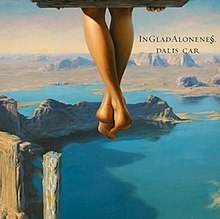
Cover to 2012's InGladAloneness EP
InGladAloneness can be described very succinctly - it is chilling. On the one hand, it amazes me how nothing seems to have changed in the 26 years between this EP and The Waking Hour. Playing the two back to back, you cannot tell that kind of time elapsed. Murphy is vocally spot on and Karn's style is just as glorious as ever, perhaps made slightly better with the passing of time. The composition of each song is true to form with The Waking Hour and the lyrics just as beautiful. The EP brings in a bit more Middle East influence, particularly with the track "Subhanallah" (which, oddly enough, is not a Dalis Car track originally).

There is something absolutely divine to this EP. It feels as if Karn knew this would be his last work. There is so much soul and emotion with every song. "Subhanallah" (translating to "God is Great" from Arabic) is a bit haunting to me. It is a dua (invocation/supplication that is part of Islamic prayer where a Muslim aims to connect with God and ask for forgiveness and favors) that is written in Turkish. While this song was not done originally by Dalis Car (Murphy recorded this somewhere around the turn of the century as it was included on the small issue of VHS tapes of The Grid), it may have been included as a parting prayer of sorts from Murphy to Karn.


The EP ends with "If You Go Away," a peaceful and soft song marked with a backing orchestra arrangement and acoustic guitar to Peter Murphy's soothing vocals. The track is a cover of the popular Jacques Brel song "Ne me quitte pas", which is said to have been one of Karn's absolute favorite songs. The song is a powerful closer to the EP in its softness, presenting a rather emotional end that stands in contrast to the other four tracks on the EP. It is a touching and emotional farewell.

Overall, I hold that this is easily the most underrated and underappreciated of all the post-Bauhaus projects. It holds a surreal uniqueness that is still true to form for both Karn and Murphy. Even more astonishing is how the two could pick up where they left things 26 years later and record a last effort on Karn's part that is beautiful, chilling, and lasting. My only qualm with this project is that there simply isn't more. Rest in peace, Mick.


More Information: Official Site of Mick Karn Official Site of Peter Murphy

Thursday, May 9, 2013

Music Re-Review: Bauhaus - Go Away White

A little over a year ago, I wrote a review on the last offering from legendary post-punk band, Bauhaus, 2008's Go Away White. (You can read that review here)

Since that review, I have listened to Go Away White a bit more and find my view of the album to have changed a bit. So, I felt a re-review was of the essence to explain my new thoughts on the album and perhaps a little of what has changed my view on it.

Bauhaus, as they looked around the time of Go Away White. Left to right: Daniel Ash (guitar, backing vocals), Kevin Haskins (drums), Peter Murphy (vocals, other instruments on occasion), David J (bass guitar, backing vocals)

I won't review the history of the band again. Suffice to say, the band has undergone three major periods - the original period from 1978 to 1983 where the majority of the music was written, recorded, and performed, the 1998/1999 Resurrection reunion tour which spurred the Gotham CD/DVD but no new material from the group, and the 2005-2008 period that resulted in Go Away White as the final offering from the group and minimal touring opening for Nine Inch Nails (the former in 2008, the latter in 2005/2006).

Recently, Peter Murphy has undergone a massive tour to celebrate 35 years of Bauhaus existing. In the past, he would play a few Bauhaus songs in his solo sets as they fit in, providing an indulging experience for fans who weren't quite expecting the rare treat. But, 35 years and the kind of influence, albeit rather underground, that Bauhaus has garnered shouldn't go without notice. So, the tour, dubbed the Mr. Moonlight Tour, features Peter Murphy with his solo work band members playing a full Bauhaus setlist. There is no "Cuts You Up," no "I'll Fall With Your Knife," and certainly no "Peace to Each." Just a divine combination of the Bauhaus hits every fan knows and loves and lesser known beauties that only the most extreme of fans would know all the words to.

Peter Murphy and the ever talented Mark Gemini Thwaite on guitar at the Granada Theater in Dallas during the Mr. Moonlight Tour. I'm also 99.9% sure this photo was taken by Bill Ellison at the Granada.

I will endeavor to write a concert review surrounding this tour at a later time. The point I am getting at here, however, is that on this tour, certain songs from Go Away White have made their appearances. And it is in this context of a full Bauhaus set, hearing some of those songs for the first time live (first time for me), that something has clicked into place.

Years ago, the very first time I saw Peter Murphy perform (June 2009, Emo's outdoor stage in Austin on 6th street and Red River) he busted out "Too Much 21st Century." It struck me as odd that he needed a piece of paper with the lyrics on it. After all, the album had been out for a year and was relatively fresh. Of course, in retrospect, I perhaps take for granted the fact that a person like Peter Murphy with such a prolific career and countless lyrics remembers the vast majority so well. And if he wasn't planning to play those songs every night, it becomes easy to see how someone wouldn't necessarily remember all the words and perfectly.

As I have remarked and has been mentioned in interviews with the band members, Go Away White draws many different influences that differ vastly from the initial influences that spurned previous albums. Go Away White wasn't exactly intended to be the continuation of the band. It wasn't meant as the big follow-up, years later, to Burning From the Inside. Instead, it was more a meeting of the minds at a middle ground, a junction that brought in their current places in their careers. After all, if you listen to any project from the four following Bauhaus, none really carried the same sort of sound or purpose as Bauhaus.

In "Too Much 21st Century," there's an argument proposed that everything in the 21st century way of living is about wanting more than what you have. Want a better actress, better singer, more money, etc. Instead of being thankful for what you do have, it isn't enough. And there is truth to this argument, I believe. Today's world is incredibly fast paced and often your best just isn't good enough. While I first found this song to be rather simplistic, I now feel there is a certain beauty in that simplicity.

Love and Rockets, the major project of David J, Kevin Haskins, and Daniel Ash post-Bauhaus
The second song on the album, "Adrenalin," was one I never gave much thought to. The lyrics basically describe what adrenalin can do to your body (kickstart your heart, make the finish just the start, etc.). However, seeing the song live in Houston on the Mr. Moonlight Tour and seeing the energy Peter Murphy put into the song, it just instantly grew on me that night. Again, the lyrics are not like the older Bauhaus songs. They aren't poetic or cryptic. They're really there at a more surface level. But something in the music and the rawness of the performance just makes this song incredible.

In the interest of sparing some reading, I won't go over every track on the album. There are still those, like "Saved," that I don't much care for even still. Instead, I will talk some on the last two songs I greatly enjoy from this album.

Track 4, "International Bulletproof Talent," reminds me of some of those old-timey spy movies. Not the ones you take seriously like James Bond, but the sort with the cheesy music and large hats and coats. This isn't to say this song is cheesy and shouldn't be taken with some kind of seriousness. But just to say that the music reminds of that sort of thing, really. It isn't much, and maybe this is a cop-out, but I really like how the music and vocals mesh on this track. Just take my word on it that it's a good one.

The final track I will talk about is perhaps my favorite from the album. "Endless Summer of the Damned" is perhaps the one song on this album that nods back to what Bauhaus's style used to be. I don't mean to say this fits along exactly beside "Bela Lugosi's Dead" or "Terror Couple Kill Colonel," but there are some beautiful lyrics to this song that I simply don't follow. A surface level reading could indicate that this is a commentary against global warming (i.e. "the ultra violet's violent" could be something to suggest that the sun has become more harsh and is harming us), but I suspicion there's more to this than the surface level suggests. Basically, my new found love for this track is based off of seeing it performed in Dallas on the Mr. Moonlight Tour. I distinctly remember getting goosebumps during this song, wondering what it was. I knew it must of been off of Go Away White and when I caught the lyrics of "the endless summer of the damned," I knew it was this song. But my goodness was it amazing! Perhaps what caught me was not just the power in the song itself, but seeing everyone on stage jumping to it and rocking out. There was something very oddly personal and inviting in that moment. I felt very connected to the performance at that moment (not to say I wasn't connected before, but more so).

Dalis Car, the rocky collaboration between Peter Murphy and ex-Japan bassist Mick Karn that spurned one full album in the early 80s, a much too short EP in the mid-2000s, and showed Peter Murphy that he had what it took to be a solo musician, capable of writing songs and music of his own
All in all, this still isn't my favorite Bauhaus album. It may very well still be my least favorite (though it is at least gaining ground on Burning From the Inside). But as I listen to it more and understand the state of mind all four members were in at the time, I begin to appreciate the album more and more for what it is. The members often describe the writing and recording of this album as spontaneous. First takes were used as the final cuts. The album was wrapped in 18 days. Much as every breakup of the band was essentially spontaneous, it should be fitting that their last contribution together would be as well. Peter Murphy has also said how he felt the timing was right for this to be the end. He had tried a few times to bring the band together again with no avail. He felt the other three were just tired and could no longer keep up. Perhaps on the outset, those words seem very harsh, but I believe there is truth to them. Merely ask yourself who the driving force of the band was. Who brought them together repeatedly? Who has had the longest and most prolific career? Who is still going strong? Peter Murphy. Sure, this may not be the end many long standing fans of the band were hoping for. In honesty, is it fair to say any of us were even hoping for an end? Probably not. But, all things taken, I feel this may have been the best end for the band.


Rating: 4 of 5

More information: Official Bauhaus website, Official site of Peter Murphy