Nick Cave and the Bad Seeds return this year with a new somber and eerie album, Skeleton Tree. This is the band's sixteenth album since forming in 1983 in the aftermath of post-punk group The Birthday Party. While still retaining various undertones of the original post-punk influence, Nick Cave and the Bad Seeds tends to lean on a more experimental musical nature, melding with Cave's visceral lyrics that focus on religion, love, violence, and death. Skeleton Tree embodies the grief and death aspect, holding the perpetual emotional weight of loss overhead.
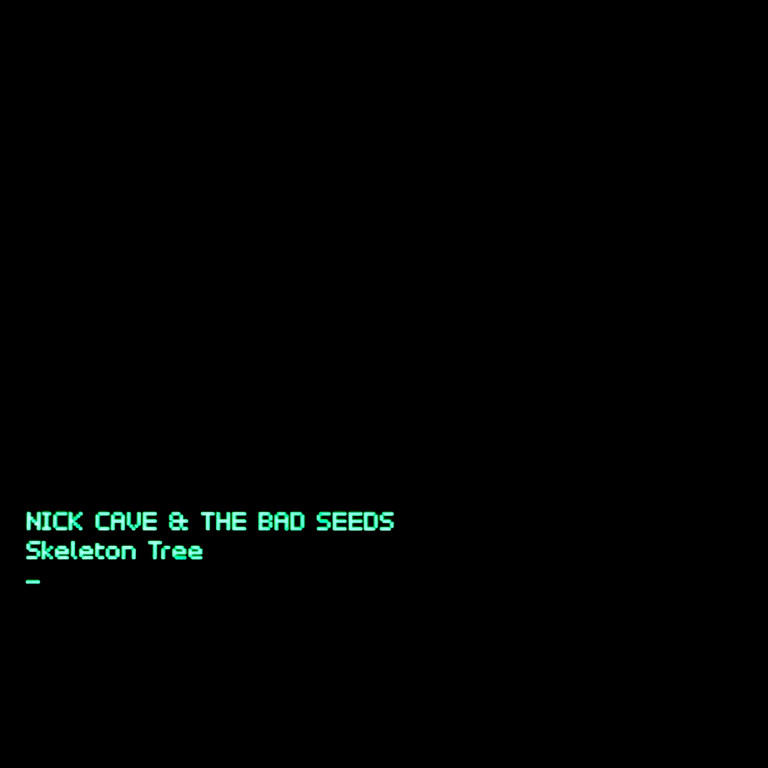
Skeleton Tree album cover
I have been hesitant on whether to review this album and how to present it. While most of the album had been completed prior to the sudden and tragic death of Cave's son last year, parts were re-recorded and re-written to reflect some of those feelings of inexplicable loss. Not to say that prior Bad Seeds albums are not heartfelt, but there is certainly a very personal tone to this one. It's Cave letting you in on some of the sorrow he's surely felt and expanding on the theme in ways he hasn't exactly addressed in the past. And how do you assess that objectively? You really don't. You can't. It's either a circumstance you've been through similarly and can therefore fully comprehend the wide range of emotion or it's something you've never been through and can only imagine and sympathize with.
Different from prior albums, Skeleton Tree is minimalistic in every sense - the album artwork is very basic, all-black with just the names on the front. Eight tracks comprise the album, which is about typical for a Bad Seeds album, but the tracks are shorter. There is no eight minute long opus on this one. Cave opts for a more reflective spoke-word tone instead of singing or bitter licks. The instrumentation on most of the album is peeled back - revolving mainly around piano chords and an acoustic guitar with some songs adding extra channels.
The album opens on the hair-raising "Jesus Alone." The track begins with an oscillating synth sound meshed to a distorted guitar that fades in and out, a solemn string arrangement tying it all together. Cave enters, soft spoken word lyrics reflecting on loss. "With my voice / I am calling you" repeats throughout, evoking the feeling of calling out to someone repeatedly, only to be met with silence, emptiness. The stage is set and there is no going back.
"Rings of Saturn" lifts the veil of sorrow that we have donned and presents a glimpse of light and realization - "And this is the moment, this is exactly what she is born to be." "Girl in Amber" brings us back to the reality of the situation, however. Linked to his wife in the album's documentary One More Time With Feeling, the song has a dual perspective feel - on the one hand, referencing a girl in amber who essentially goes through the movements without feeling them (possibly referring to Cave's wife and how she handled their son's passing in the immediate days following the accident). On the other hand, the song references a spirit trapped between this world and the next with Cave saying it's okay, you can go - "And if you want to leave, don't breathe a word / And let the world turn..."
"Magneto" and "Anthrocene" continue the journey we've embarked on, delving into Cave's mind. Minimal in nature, both showcase Cave's cryptic lyrical prowess and a contemplation on higher powers. The deeply reflective "I Need You" is the ultimate point of the album. Cave ventures to sing more on this song instead of speaking, bringing a heart-piercing vulnerability to the foreground. I was initially turned off of this song because Cave's voice isn't quite in the right key for this one, but I think that's part of the point - to be so emotional that nothing is quite right and the same anymore. If crying could ever be put into music, this is the song to do that. Maybe it's easy (and incorrect) to assume this song is about as personal as it gets, but you can imagine a tearful Cave directing parts of this to his wife (notably the first half of the song) and others to his son (the second half, largely), in both cases wrought with anguish - "I need you, I need you, I need you."
"Distant Sky" transitions much as "Rings of Saturn" did to take a look at the larger picture and find some means of resolution. Else Torp guests on this one, giving an almost lullaby feel, telling the spirit to rise and let go. The album closes on the brighter self-titled track with a glimpse of moving on - "And it's alright now." You'll never be the same, but there is life after tragedy. It will be alright now.
The album, even with its ambient leanings and stripped down nature, is beautiful. Even as it conveys the grieving process perhaps specific to Cave's situation, it's one that can easily be extrapolated to apply to anyone's grieving process - be it the loss of David Bowie at the start of the year, the loss of a friend, or, in Cave's case, the loss of a close family member. This isn't an album to be listened to in one sitting before forming a final decision. As I continue to listen to it still, my perception of the album keeps changing. There's a subtlety to it that takes several listens to become apparent. It's a strong album, but the tragedy in it is that it took such a catastrophic loss to birth it. My heart breaks all over again for the Cave family.
London post-punk "revival" (so quoted because they sound and feel more like an original 80s UK post-punk group than the 2000s revivalist groups in the vein of Franz Ferdinand and the like) Savages have returned with a new album, Adore Life. The album follows on the heels of their very successful debut album, 2013's Silence Yourself.
Savages have released their second album, Adore Life
Silence Yourself carried a very traditional post-punk sound and aesthetic, drawing heavy influence from groups like Siouxsie and the Banshees and Joy Division. While a strong album, it was a bit light in the experimental nature that surrounded the original 80s post-punk genre. Adore Life brings that experimental nature to the forefront, resulting in a dynamic album that effortlessly navigates faster, traditional post-punk tunes through slower, ballad-like numbers, all without losing the listener or leading to the often ill-fated "never-ending-album-will-someone-please-turn-it-off" syndrome that over-experimentation can cause.
Adore Life opens with "The Answer," a distortion-laden song revolving around love and adoration. The song presents a larger focus with a driving bass line supplied by Ayse Hassan and a guitar solo from Gemma Thompson. The frantic guitar throughout the song strongly parallels singer Jehnny Beth's vocals with lines like "I'll go insane / Please stand up / What is the point?" which detail some of the struggle in determining how someone feels about you.
"Evil" starts off with an interplay between Hassan and Thompson that sounds vaguely similar to Killing Joke's "New Cold War" from Pylon (2015), though minus the heavy distortion industrial-leaning sound. Fay Milton on drums rounds out this number, providing a solid background with minor layers of detail that enriches the song further.
What makes Savages, in my opinion, more like the original post-punk bands and less like the modern "revival" post-punk bands is how many of the songs are highly bass-driven. "Evil" is just one example with "Sad Person" being another. Bands like Bauhaus and Joy Division are largely loved on a music level due to this somewhat unique quality, where the bass and drums provide much of the meat and drive of a song with guitar adding little flourishes here and there.
The album's title track opts for a slower, more reflective tone, led largely by Hassan on bass. Beth's lyrics center around a question of humanity and whether the idea of adoring/valuing life is unique to people and contemplates on past actions and whether it was best to do those, even if they led to negative endings, resolving that even if you have regrets, you lived life, you adore life because you continue on.
Adore Life continues in much the same manner as the early songs, offering driving music matched to Beth's Siouxsie Sioux-esque vocals. Songs like "When In Love" and "Surrender" deserve additional praise, the first for one of Thompson's opportunities to shine on guitar, and the latter for a very synth-layered bass backing from Hassan that nods back to 80s new wave meets darkwave sentiments.
Savages are set to tour this spring in support of the new album, reaching Dallas on April 11, playing at Trees. With two strong albums under their belt, and perhaps the only band to play an amazing show at 8am on a Tuesday morning, this is not a show to miss. Tickets are on sale now and can be purchased here.
John Lydon (perhaps better known by his punk stage persona Johnny Rotten) founded arguably the first post punk outfit in 1978, Public Image Ltd, after punk rock essentially met its ill-fated and rapid end with the death of fellow Sex Pistols bandmate Sid Vicious (okay, there's much more to the story than just that, but as far as the genesis of Public Image Ltd is concerned, that was the defining moment). Public Image Ltd (PIL) return in 2015 with their tenth album, What the World Needs Now... and it's a doozy.
Album cover for What the World Needs Now...
Part of what made the post punk genre a lasting and highly influential one was born out of the blank void punk left behind in the late 70s. Punk challenged the boundaries of what "music" meant and served as a means of expression for working class youth faced with rough world economies and questionable, at best, futures. Without getting into an extended discussion of punk's beginnings, rapid dissolution, and the rise of post punk, understand that the music industry shifted perspective in the 70s and that post punk was born in a period where extreme creativity was highly encouraged. Punk showed the world that you didn't need to have any particular training to be a musician - anyone with the desire to express themselves and play music could, and should, do it.
PIL from its very inception was one of the bands at the forefront of this limitless musical landscape. Where the Sex Pistols followed in traditional punk rock bravado (power chords and anarchist-leaning lyrics, typically speaking), Lydon took PIL to a very different space, welcoming a slower tempo and more innovative music led by a heavy bass sound and coupled with Lydon's distinctive, bitter snarl.
John Lydon at Fun Fun Fun Fest in Austin, Texas, back in November 2012. Despite the interview and stage antics, he was very nice to talk to, though short of words at the time.
With this brief overview in mind, delving into What the World Needs Now... is like taking that rich past and setting it on fire. This is an album that has vastly deviated from so much of what originally defined PIL that it's hardly recognizable as a PIL album. Even Lydon's typical jabbing half singing, half yelling affair is greatly lacking in this latest showing.
What the World Needs Now... opens with lead single "Double Trouble." This number is characterized by a rather drab mixture of guitars and drums, nothing standout musically. Lyrically, Lydon seems to have strung together a series of random words with the only requirement being that the lines rhyme. The subject matter, apparently based around an argument Lydon had with his wife about a plumbing issue, leaves little to the imagination and is perhaps the negative side of an artist crafting lyrics around personal anecdotes.
Songs like "Bettie Page" and "C'est la Vie" had the subtle sparks of being great songs, at least where the music is concerned, but were met with lackluster lyrics and a run-on of garbled vocals that hardly hearkens back to the style Lydon is most known for. If one didn't know better, they'd ask if Lydon even was the singer for most of these songs.
"Spice of Choice" interrupts the opening rubbish of the album and proves to be a surprisingly solid track, capitalizing on an interesting guitar lead and a strong vocal showing from Lydon who finally proves that he still has the same talents which first catapulted PIL to instant success in the 80s. This high point is immediately dulled with follow-up song "The One" which more closely resembles a lost b side for Three Dog Night than a PIL song with its bass driven shuffle step feel and semi whispered singing vocals from Lydon. The song itself isn't bad, but feels out of place when compared to the typical backdrop of a PIL song.
Eight minute opus "Big Blue Sky" starts with a dominant bass line, only to be caught in a far overdone circle of repetitious loops and tired choruses. This was a song nearly doomed from the start, never finding a true calling and purpose, and the eight minute length only adds further insult to injury.
The last of the album surprisingly comes to life and finds direction. "Whole Life Time" brings the tide back around, with a funk-esque inspired bass line leading the way, a musical high point to the album. The style continues on into "I'm Not Satisfied" which almost has a parallel feel to one of PIL's most popular songs, "(This is Not a) Love Song" with a similar repetitious lyric that the rest of the song is built around. The album is rounded out with Lydon answering minimally what it is the world needs now: "Another fuck off." More aptly, what the world needs now is for Lydon to find direction for this reincarnated form of PIL.
Perhaps much of this latest offering from PIL was intended as a joke, but it's one that never reached the punchline. In a time where older bands are reuniting and putting forth new albums to stand beside their old glories, PIL goes the way most of these bands are going - dismal, at best, results with songs that never fully form a direction. Lydon's vocals try to save several of the musically lackluster songs, but even his voice has its limits. Perhaps a stronger showing than their previous album (2012's This is PIL, the group's first new album in twenty years), but certainly a far cry from what PIL once was. Lydon will need to take a much closer look moving forward. If this was meant as a joke album, it's time to grow up and either create meaningful work once again or stop taking the fans for fools who will buy anything. Not an impressive showing in the least. Sorry, Johnny.
PIL begins an extended tour to support What the World Needs Now... on September 18, 2015 in Glasgow. The group reaches the US in November, but no tour dates in Texas have been announced as of yet.
It's been a long time (general business with a long term web project I've undertaken and going back to school), but some of you have asked, and so here I am with a new addition to the music reviews! It's been a major buzz topic these last couple weeks, but today we'll look at Siouxsie Sioux's latest musical offering, "Love Crime."
Siouxsie Sioux
For those who follow the post punk genre as I do, the name Siouxsie Sioux is unmistakable. She is to the post punk world what Elvis Presley was to rock in the 50s. Always one for a distinctive style, be it in physical appearance, musical style, or witty comebacks during interviews, Sioux has always embodied a particular penchant for reinvention in each music project she's endeavored. From the seminal work as Siouxsie and the Banshees, arguably one of the defining bands of the 80s British post punk offerings, to the percussive-heavy project The Creatures, to an eclectic yet familiar powerful first solo album, Sioux is perhaps one of the very few artists who does great things regardless of the project, having yet to make a large musical mishap.
As it were, following a strong debut solo album (2007's Mantaray), Sioux would essentially drift off into the shadows, making small appearances here and there as a reminder that she's not gone, just hiding. Brooding. Much with David Bowie's mysterious ten year hiatus, Sioux would seemingly vanish for approximately eight years. After all that time, the "Ice Queen" returns with a new song, "Love Crime."
Brian Reitzell
Sioux, a fan of the television series Hannibal, was tapped by Brian Reitzell (former drummer of Redd Kross and current musical supervisor and composer for the Hannibal series) with the suggestion of a collaboration. Sioux immediately agreed and inquired what the final season would more or less be about - a love story, as it were. Sioux began writing lyrics without having seen any of the final season or receiving any major details on the overall plot line. What resulted was "Love Crime," the first song Sioux has written and sung in roughly eight years, and possibly the first of many in a line of collaborations with Reitzell.
The song itself is on the slower side, reminiscent in some cases of 1992 Banshees hit "Face To Face" (featured in Batman Returns). It is an eerie song, driven by drums, violin, and bass, before a moving guitar section kicks in behind Sioux's ever refined and spotless vocals. Though cliched as it may be, Sioux is a perfect example of how age can make the voice even stronger and richer than it was already. Listening to this song literally gave me goosebumps. It's a glimpse into what Sioux could have been doing all these years, but has kept pent up instead, evolving and growing into an incredibly strong first showing in eight years. Not that Sioux needs my approval or anyone else's, but "Love Crime" makes a strong argument for her full return to music. Let's just hope that future collaborations between her and Reitzell find their way to a music release...and sooner rather than later.
Today's Music Review will be of Peter Murphy's tenth album (ninth studio), 2014's Lion.
Cover art for Lion
If there is one thing to expect about the "Godfather of Goth," it is to expect the unexpected. Over more recent years, Peter Murphy's career has gone places few would expect - starting perhaps with a turn of the century reinvention that spurred 2002's unique masterpiece, Dust, followed by 2004's return to pop rock form that Murphy had previously built his career on, Unshattered, and ending most recently with 2011's rock triumph full of attitude and energy, Ninth.
Lion, produced by Youth (Killing Joke), is everything you would expect from Murphy at this point and still so much more than you could have guessed. With most of the tracks originally written and recorded on the spot in the studio and in the span of only a handful of days, the album flourishes with an immediacy that makes Ninth feel tame in comparison. Richly sprinkled along the slew of single-worthy anthemic songs are compassionate, emotional ballads that still show off Murphy's rich vocal prowess and beautiful lyrics.
The album opens with the first single, "Hang Up," a synth-heavy song laced with screaming vocals that have been atypical of Murphy's career so far. Afterwards, the album winds into the electro-dance song "I Am My Own Name," which may be Murphy's response to much of the criticism he received in 2013 for endeavoring to do a full Bauhaus tour around the world without the other three original members of the band.
Amid the instantly dance-able songs come slower, passionate pieces that are a bit more reminiscent of Murphy's earlier works, including "Compression," "The Rose," and the soaring "Loctaine." Perhaps a nod back to Murphy's roots in the 80s music scene, songs like "Holy Clown" and "Low Tar Stars" carry the feeling of an 80s new wave song created for the dispossessed (the latter in particular sounding like the dark version of Michael Sembello's 1983 hit song "Maniac").
Lion rounds out with other notable songs "I'm On Your Side" and "The Ghost of Shokan Lake." "Eliza" is a slight change of pace for Murphy, not focusing so much on forms of love, introspection, and religious ideologies, but instead on the idea of leaving self-blame behind, being yourself, and celebrating life.
Murphy's tenth album ends with the title track "Lion," which has a lofty, atmospheric background music to fill in around Murphy's lush, deep vocals, creating a song that alludes to some of the many qualities of an actual lion - powerful, majestic, and encompassing. While not a fast, hard hitting song to round out the album in a fashion of how it started, "Lion" leaves the listener with a feeling of completing a musical journey guided by Murphy through introspection, religion, history, and even a glimpse into the future.
Lion is the rock-dominated album many would expect of him following Ninth. Given his desire on the previous album to prove a point of existence and importance, Ninth was in some regards the album Bauhaus never made, serving to assert Murphy's place as a solo musician and a rock star. Lion is the vastly more experimental follow-up to Ninth now that the audience and self-imposed (to some extent, at least) expectations of the former Bauhaus-frontman are squashed. What comes next only Murphy knows, but Lion may well be one of the best works he has done to date, combining much of what he was originally loved for during the Bauhaus years, the complex lyric writing that has persisted throughout his solo career, and an ingenious musical progression that is neither forced nor completely alien to long time fans. This album will certainly be on repeat for a long time to come.
Peter Murphy will be joined by current band members Emilio "Zef Noise" China (bass guitar, violin), Andee Blacksugar (guitar), and Nick Lucero (drums) for a tour of North America to support Lion that begins June 9, 2014 in New York. Peter Murphy visits Austin at The Belmont on July 29th with local favorites My Jerusalem providing opening support once again (they opened for him on last year's Mr. Moonlight Tour).
(Note: Yes, I know the photos are missing for some reason. The site I wrote this article for originally seems to have taken them down. Working to get it fixed, but until then, this posting will look a bit odd)
Strap On Halo (Omaha, Nebraska) visited Austin back on Friday, March 21st as part of the Near Dark Tour along with late-80s post-punk/gothic rock group The Last Cry (Brighton, England) and DJs Martin Oldgoth and Augustine Strange.
Strap On Halo / Laura Davila
Taking the stage first, Strap On Halo performed a 12 song set that heavily focused on their recent EP, Haunted, and visited tracks from their past work, including their debut album The Dead Don't Lie. With each song, frontwoman Layla Reyna's vocals shined mercilessly, soaring from note to note as she sang about various things that could haunt a person. Original founder Sean Rial added to the gloomy mood with a lacing of guitar work that wove between the programmed beats and synthesizers to add an ethereal tone. Bass guitarist Marc Jones rounded out the lineup with his enthusiastic play and fun stage presence. The first half of the set saw Strap On Halo guide us through "Only In Death," "Monsters," and perhaps my favorite off the Haunted EP, "Hunger." While small, the audience enjoyed dancing and bopping their heads in time to the music. As Strap On Halo began to wind down the full set, they pulled out the reworked version of "Strigoi" and "You And Your Ghost."
Layla Reyna of Strap On Halo / Laura Davila
Overall, their performance was amazing. The fog machine was a little distracting, but the three took it in stride and made it work for them. Reyna's vocals were perfect as ever, commanding a similar stylistic quality in person, as on recording, to that of Siouxsie Sioux herself. Rial and Jones both made their instruments come to life, taking them far beyond the traditional roles a guitar and bass guitar play in a band. The only pitfall of the night was that only a small handful of Austinites were there to witness these guys.
Following Strap On Halo were The Last Cry. Having formed in the late 80s, The Last Cry only have two full length albums due to a series of lineup changes and a hiatus during the 90s. On stage, however, the band are as lively as any new act and eager to draw people in. Their sound, as one may expect, is very reminiscent of the original dark post-punk bands, sounding like a mesh of The Cure and Depeche Mode.
The Last Cry / Laura Davila
Frontman Andrew Birch sang each song with a passion and intensity that was very catching. Vocally he sounded very similar to Dave Gahan (of Depeche Mode) which worked very well with the style of music played by the other members of the band. On guitar, Tim Green played with precision and control while also manning the laptop to make the appropriate transitions between songs. Rounding out the group is Chris Carey on bass guitar who also played with great passion and movement on stage. The only thing that felt a bit strange about The Last Cry was that they have no live drummer when the music would be well complemented with one. Additionally, while the crowd had picked up a little more from Strap On Halo's set, it was still a bit thin for The Last Cry which I think was a shame as you all once again missed out on a great group.
The night was made complete with excellent music selections from DJs Martin Oldgoth and Augustine Strange who both played a range of music surveying goth rock, post-punk, industrial, and everything between that the goth culture has laid claim to.
Overall, the Near Dark Tour was a wonderful experience and a great opportunity to learn about some great bands that should be far bigger than they currently are. If you weren't here, you honestly missed out on a fun night with very talented people. The Near Dark Tour just reached its conclusion, but keep an eye out for both of these bands as their future is bright (or should I be saying it's gloomy because, you know, goth music?).
Note: Apologies for the large delay in this posting. There's been a bit of a snafu with media postings at the site Laura and I were with, so in an effort to at least ensure the word got out about this show, I've moved it here to this blog (formatting is also a bit off, so I'll look at fixing that soon). We did conduct an interview with Strap On Halo, but a lot of the audio we took has unfortunately been lost. I'll see what I can salvage from what's left.
It's been ages folks, but we're back with more music and show reviews for your reading pleasure. A little late to the bandwagon, surely, but as a welcome back to everyone, today's Music Review will be on Peter Murphy's second single off of Lion, "I Am My Own Name."
Peter Murphy, 2014.
Murphy approaches Lion from an interesting standpoint - it will be his tenth album (ninth studio), the follow-up to his successful rock monster Ninth (his prior work has categorically fit under pop rock where Ninth became his first solo album to firmly grasp the rock field and take it by force), and an album born mostly during a time where the singer revisited the vast catalog of his original band, British post-punk act Bauhaus.
"I Am My Own Name" is a healthy dose of everything you expected given the above (a very gutsy, complicated mesh of emotion and freedom), and yet Murphy surprises the listener by throwing in something utterly new and foreign - synthesizers in a Numan meets Reznor-esque produced dance track for the dispossessed.
The song opens with moody electric violin work from current bass guitarist and violinist, Emilio "Zef Noise" China. In a style that classically eludes to the Middle East (which Murphy, who has called Turkey home for the last roughly 20 years, has done on nearly every album, both subtly and dramatically), this soft introduction begs the question of "What is he doing? What does Murphy got up his sleeve?"
The vocals then kick in, smooth at first, but then with an edge, a harsh scream as Murphy declares that he is "[his] own name." The song then gains in tempo, guitars and drums starting as Murphy tells his story of who he is and is not, merely to say that he is his own name, for what that may or may not mean.
"I Am My Own Name" lyrically appears to focus on some of the recent naysayers who have criticized Muphy both professionally and personally. Some such lyrics include at the beginning "No thin Pixie/white and drawn/no shaded shadow...no jaded shock star..." (Apologies for any errors in the lyrics as they've not been published and this is a best guess) The first part about not being a pixie could be a reference back to the Bauhaus song "Crowds" which has the line "A slim Pixie, thin and forlorn," suggesting that he may not be so innocent and gullible, in a sense, as he was when younger and also not depressed as many have been led to think (also in line with the upbeat tone of the music). "No shaded shadow" to perhaps mean he is no longer going to "hide in the shadows" and not do certain things because it is frowned upon, and not a jaded shock star as there is more value in his work than just going for the easy shock that many stars today try for.
Whether these interpretations hold any merit is, of course, unclear. However, Murphy takes us down an interesting journey with this song, proving once more that he can do something incredibly different, yet still make it his own without alienating the listener. One thing is for certain with this song - if it is performed live and no one is moved by it, either physically or emotionally, nothing will move them.
Lion, produced by Killing Joke's Youth, roars to life June 3rd. Murphy kicks off his North American tour to support Lion June 9th in New York and will visit Austin July 29th at The Belmont (regular and VIP tickets on sale now). Finally, Murphy is in the middle of a Pledge Music campaign to fund the release of a live DVD from the Mr. Moonlight Tour. Check it out here and support today!
Today's Music Review will cheat a tiny bit and be of not one, but two, offerings from the short-lived collaboration of Peter Murphy and Mick Karn - Dalis Car.
Dalis Car in 1984 - Peter Murphy (vocals) on the left and Mick Karn (bass guitar, saxophone, synth, flute) on the right
1982 was a tumultuous year for both members of Dalis Car. For Peter Murphy, it was the sign of the end of Bauhaus coming. October saw the release of The Sky's Gone Out, a decidedly dark offering from the British rockers that was met with mixed reviews leaning more to the negative side of the scale than positive. Among the four members, there was growing tension about the direction in which to take the band. As tensions mounted, the group toured in early 1983 before settling down to record their fourth studio album. It was during this time that Peter Murphy fell ill with pneumonia, spending time in the hospital and unable to record. The remaining members of Bauhaus decided to go forward without Murphy, writing and recording most of the album before he was well enough to come to the recording sessions. This, combined with unease over Murphy being given more of a spotlight by the press (with a semi solo appearance in the opening scenes of The Hunger and appearances in a string of Maxell ads not helping matters any) resulted in the band disbanding shortly after recording for Burning From the Inside had been finished.
Bauhaus in 1982 before the group split. Left to right - Peter Murphy (vocals), David J (bass guitar), Daniel Ash (guitar, saxophone), Kevin Haskins (drums). Image from Ondarock's website
Similarly, Japan's rise to fame was also becoming characterized by immense personality clashes among the members of the group and eventually deep personal clashes (notably between Mick Karn and David Sylvian). 1982 marked the release of Tin Drum which would be the final Japan album. The album resulted in one of the group's most popular songs, "Ghosts," which reached number 5 on the UK pop charts. The group went on a farewell tour following Tin Drum's release. Most of the members of Japan went on to other projects and solo careers of their own.
Japan. Right to left - Mick Karn (bass guitar), Steve Jansen (drums), David Sylvian (guitar, vocals), Rob Dean (guitar), and Richard Barbieri (keyboards). Image from Japan's Last.fm artist page.
How Peter Murphy and Mick Karn met is a bit of a legend and depends on whose story you wish to follow. Musically, Japan and Bauhaus are not very similar (yes, both rose from the ashes of the punk movement, but Japan was more in the New Wave/New Romantic vein while Bauhaus remained more in the post-punk and media-dubbed "Goth Rock" arena). Per Karn's version, his agent had heard of Bauhaus splitting and saw Peter Murphy as the yang to Karn's yin. Where Karn was not known for being a lyricist and vocalist, Murphy was not know as a musician in the purest sense. His agent suggested the two work together, Karn agreed they try it out, and the two parties came in contact. Per Murphy's version, he was conducting a post-Bauhaus interview and was asked who he'd collaborate with if he could work with anyone. Not thinking anything of it, he said Karn's name as he was drawn to Karn's musical genius. Days later, Murphy came home to a message on his answering machine - from Karn himself proposing they start a new project together!
Perhaps even more mythical is how the duo came to call the new project 'Dalis Car'. One prevailing theory that has been denied by Murphy and Karn attributes the name to a Captain Beefheart song (the song being titled "Dali's Car" from his 1969 album Trout Mask Replica). Another theory centers around an art exhibit in the late 1930s that featured a piece by surrealist painter Salvador Dali (dubbed 'Dali's car'). The final prevailing theory revolves around a dream Murphy had one night of being offered to buy a car from Salvador Dali that would grant a "mystical" experience. Regardless of the true series of events, Karn and Murphy agreed to begin a new project in 1984 and opted to name it Dalis Car.
Things were difficult for the two from the get go. Both preferred to work alone on the songs, sending tapes back and forth through the mail as opposed to working together in the studio. This eventually resulted in their first release, 1984's The Waking Hour (with "The Judgement is the Mirror" released as the only single from the album) before the two split to each embark on their own solo careers. Part of what prompted the split stemmed from the difficult writing conditions and how each wanted to dominate the project (since both had seen success in their respective pre-Dalis Car endeavors). Additionally, reviews of the debut album were far from flattering, pointing out that the album was a literal mashup of the duo's strengths with nothing additional from outside the box. While Dalis Car was not nearly as popular and successful as one would think, it did result in something rather positive for Peter Murphy.
Most of the music and lyrics of Bauhaus were not written by Peter Murphy at all. It wasn't until The Sky's Gone Out that Peter Murphy wrote and composed a few songs on his own (particularly "All We Ever Wanted Was Everything" where he wrote the music surrounding some of the first guitar chords he learned to play while Daniel Ash supplemented the lyrics and "The Three Shadows, Pt. II" where Murphy composed all the music). Post-Bauhaus, there was some doubt as to whether Murphy could pull off a solo career. Did he have the experience? Did he have the musicality? Many skeptics thought not. With Dalis Car, Murphy had more free range in writing the music and the lyrics, proving that he could do this on his own. With Dalis Car dissolved in 1985, Peter Murphy went on to start his solo career, releasing his first album in 1986 (Should the World Fail to Fall Apart). His writing style would initially require a muse through which to convey his thoughts and turn them into actual notes, but the unique method would pay off handsomely with a very loyal fan base and near mainstream success with his third album, Deep.
Still going strong, Peter Murphy. From the May 7, 2013 show on the Mr. Moonlight Tour at Webster Hall in New York City. Photo from The Bowery Presents website.
Over the years since Dalis Car first met, Peter Murphy went on to release eight studio albums and even tried to reunite Bauhaus twice, first in 1998 on the Resurrection Tour (which was to hopefully result in a new studio album, but those plans were cut short as the group quickly disbanded again after the tour) and again in 2005/2006 to tour mostly as openers for Nine Inch Nails (2008 did see the fifth and final Bauhaus album, Go Away White, released, but no touring would take place to support the album as the album itself was barely finished due to more struggles among the members of the group). Mick Karn, on the other hand, went on to release numerous solo albums, collaborated with several musicians, and write a book about his life up to 2006, intending to write another book about his life in time.
By this point, Dalis Car was as dead as Bela Lugosi. No one had really given the short-lived project any thought. 2010 came rolling around, 26 years after Dalis Car had formed and disbanded. In June, Mick Karn announced on his website that he had been diagnosed with terminal cancer (the type was never revealed). His family was struggling financially with the medical costs and they sought help from his fans. Many helped and several tribute concerts were staged to help raise money for the ailing Karn. For fans, this was the worst news they could ever receive. Mick Karn, talented musician, integral part of Japan, master of his own solo work, was dying at the young age of 51.
A more recent picture of Mick Karn. Photo from thegoldenyear.wordpress.com
Unexpectedly, in August of that same year, Peter Murphy posted a video to his Facebook account (which was quickly removed/hidden) where he disclosed to fans that he was teaming up with Karn again to revive Dalis Car one more time and that the two would begin working as early as September. It was the first time the two would see each other since 1985 (link).
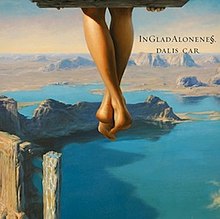
While the two planned to record a full length album, Karn's health fell dramatically and quickly. Karn lost his battle to cancer on January 4, 2011, at the age of 52. Only five tracks were finished, released in April 2012 as the EP InGladAloneness. The original Japanese release included a book with photos taken by Steve Jansen (Japan's drummer and who remained friends and collaborators with Karn over the years) and comments from artists who had worked with Karn on his legacy and life. On July 24, 2013, what would have been Mick Karn's 55th birthday, InGladAloneness was made available for purchase again with 100 copies signed specially by Peter Murphy with all proceeds going to the Mick Karn Appeal Charity to help his family.
Cover to 1984's The Waking Hour
The Waking Hour is incredibly characteristic of both Murphy and Karn. The bass licks Karn recorded are unmistakable signatures of his style. Vocally, Murphy sounds much as he did while in Bauhaus, complete with beautiful, cryptic lyrics. Different for Murphy, however, is the style of the music, featuring a slew of other instruments aside from the drums and bass guitar that were heavy players in Bauhaus's music with guitars used mainly to add texture to songs. Also lacking on the album were the screams and shouts Murphy tended to cast in later Bauhaus recordings. On a certain level, Dalis Car was what one might expect - a sum of its parts.
The second track, "His Box," features a Middle East-influenced synth part that makes this track stand out. A gorgeous track, Murphy does wonders in creating the harmonies on vocals. The bass guitar is characteristic of Karn, yet inviting. Flutes and guitars add rich flourishes to this song. Personally, I think this one would have made a fine single as well had the album been viewed a bit more favorably and if Karn and Murphy would have continued further on this project.
"The Judgement is the Mirror" is the only single from the album, characterized with dominating synth and bass guitar to Murphy's smooth vocals. Drums don't feature very prominently on this track. This one serves as a beautiful ending to the album. The music video features both Karn and Murphy dressed in full suits passing off a laserdisc in a manner that nods back to them being the yin to the other's yang.
Other stand out tracks include the synth dominated "Cornwall Stone," the self-titled "Dalis Car," and absolutely stunning musical "Artemis" (which receives a "face lift" on InGladAloneness with some updated instrumentation and lyrics). In all, there honestly isn't a bad track on this album and while it may have elements highly characteristic of both musicians, I don't see why that should be considered a bad thing.
Cover to 2012's InGladAloneness EP
InGladAloneness can be described very succinctly - it is chilling. On the one hand, it amazes me how nothing seems to have changed in the 26 years between this EP and The Waking Hour. Playing the two back to back, you cannot tell that kind of time elapsed. Murphy is vocally spot on and Karn's style is just as glorious as ever, perhaps made slightly better with the passing of time. The composition of each song is true to form with The Waking Hour and the lyrics just as beautiful. The EP brings in a bit more Middle East influence, particularly with the track "Subhanallah" (which, oddly enough, is not a Dalis Car track originally).
There is something absolutely divine to this EP. It feels as if Karn knew this would be his last work. There is so much soul and emotion with every song. "Subhanallah" (translating to "God is Great" from Arabic) is a bit haunting to me. It is a dua (invocation/supplication that is part of Islamic prayer where a Muslim aims to connect with God and ask for forgiveness and favors) that is written in Turkish. While this song was not done originally by Dalis Car (Murphy recorded this somewhere around the turn of the century as it was included on the small issue of VHS tapes of The Grid), it may have been included as a parting prayer of sorts from Murphy to Karn.
The EP ends with "If You Go Away," a peaceful and soft song marked with a backing orchestra arrangement and acoustic guitar to Peter Murphy's soothing vocals. The track is a cover of the popular Jacques Brel song "Ne me quitte pas", which is said to have been one of Karn's absolute favorite songs. The song is a powerful closer to the EP in its softness, presenting a rather emotional end that stands in contrast to the other four tracks on the EP. It is a touching and emotional farewell.
Overall, I hold that this is easily the most underrated and underappreciated of all the post-Bauhaus projects. It holds a surreal uniqueness that is still true to form for both Karn and Murphy. Even more astonishing is how the two could pick up where they left things 26 years later and record a last effort on Karn's part that is beautiful, chilling, and lasting. My only qualm with this project is that there simply isn't more. Rest in peace, Mick.
Today's Concert Review is of Adam Ant (and The Good, The Mad, and The Lovely Posse) when he played The Belmont here in Austin on 7/26/13.
Adam Ant. Image from Brooklyn Vegan
I've been an Adam Ant fan for a few years now and was fortunate enough to see him on tour the last time around (I forget when exactly, but sometime late 2012) when he played at Emo's East. I was really impressed by that show and loved how he played most of the hit songs everyone loves but also threw in some rarer goodies and some tracks from the new album. I was also impressed with his band and the fact he used TWO drum sets.
Upon arriving at The Belmont, I ran into a friend (who I met the last time I was at The Belmont in April seeing Peter Murphy for the fifth time). We got some decent spots towards the front, left side of the stage and chatted for a bit until the openers came on.
Prima Donna were the openers for the night. Prima Donna are a band out of Los Angeles that formed in 2003. Unlike traditional rock bands of today, the group prominently features keyboards and saxophone on most of their songs in addition to the more traditional guitars, bass guitars, and drums. The group clearly draws influence from the likes of David Bowie, Marc Bolan, and to a certain extent, even Mr. Adam Ant himself.
Prima Donna. Also featuring the amazing death hawk of a person in front of me. Picture taken by me
They played a modest set including a few songs off their 2012 album Bless This Mess (notably, "Sociopath" and a tribute to Adam Ant, "Maxine"). Throughout the set, the group maintained an incredibly high level of energy with singer Kevin Preston constantly darting from one side of the stage to the next, leaning over the crowd and getting in people's faces, and dropping to his knees only to fly back up. Overall, the group sounded great and did a nice job of getting us pumped up for Adam Ant.
Adam Ant began as the singer of post-punk act Adam and the Ants before going solo in 1982. Over the years, Adam Ant has spurned several hit singles from his albums (both as Adam and the Ants and solo), remaining a constant force to be reckoned with. While focusing on music from a young age, things haven't always been perfect for Adam Ant. At the age of 21, the singer was diagnosed with bipolar disorder and has had many problems over the years handling the effects of medications used to treat the illness. While not perfect, he appears to have things under control nowadays and has always been courteous to his audience (in my experience).
A younger Adam Ant from the "Stand and Deliver" music video. Picture from jango.com
Once it was time for Adam Ant to perform, the lights completely cut out and a screen at the back of the stage was lit up with "Adam Ant and the Good, the Mad, and the Lovely Posse" and the new logo for the Blue Black Hussar himself. Tchaikovsky's "1812 Overture" blared over the speakers and we began to clap in rhythm to that music. The band members began to take to the stage to our loud cheers. Then we roared to life as Adam Ant took to the stage, wearing his traditional pirate-esque regalia and an attitude that said "It's time to go crazy." The group started into a song off the new album (2013's Adam Ant is the Blue Black Hussar Marrying the Gunner's Daughter), "Marrying the Gunner's Daughter."
As before, Adam Ant maintained an immense energy throughout the entire set (even in the Texas heat!). Taking pictures of him was difficult as he darted from one side of the stage to the next without ever seeming to pause. The band sounded marvelous just like the previous time I had seen them, matching energies with Adam Ant.
The band roared through many classic Ant favorites, including "Beat My Guest," "Goody Two Shoes," "Stand and Deliver," and my personal favorite (though I don't care for the live version as much because it desperately...haha, pun...needs that trumpet part) "Desperate But Not Serious." The group came back out for a three song encore amid our shouts for more Antmusic (which I've linked a video of below, from the first time I saw him here in Austin over at Emo's East).
Ultimately, this was another fine performance from the Blue Black Hussar. He continues to sound flawless after all the years and his stage energy is certainly a force to be reckoned with. While it would have been nice to get a handshake or two, he still talked to the audience every now and then and was kind enough to give a couple fans the bandanna he was wearing on his pants for a time and one of his pirate gloves, a nice gesture on his part that won't be quickly forgot. The set was a wonderful mix of classic Adam Ant songs with only a few off the newest album. Overall, the crowd was very into the show and singing along at the top of their lungs and screaming adoration for Adam Ant. He is most assuredly not a performer to be missed, so be sure to check him out when the tour comes near you!
Best shot I could get of the set list on stage. They didn't have many to hand out and stage crew were too busy to quickly hold down the corner for me to get a better picture.
After I believe three previous efforts to see these guys, I finally bring you a Concert Review for The Psychedelic Furs! The show took place 7/18/13 at Antone's here in Austin, Texas.
The Psychedelic Furs. Left to right: Mars Williams (clarinet and saxophone), Richard Butler (vocals), and Tim Butler (bass guitar). Photo taken by me.
I've tried for the last four years, I believe, to see the Psychedelic Furs. I've bought tickets about three or four times, but inevitably I'd end up having an exam get scheduled or a major presentation or project the day after the show, ultimately thwarting my chance to see these guys live. Last night, the stars finally seemed to align just right and I was able to go to the sold out show here in Austin!
This was my first time at Antone's, either the old venue which is now Infest or the new one. The venue was smaller than I expected (I figured Antone's would upgrade in size much like their neighbor, Emo's, did compared to their original downtown location), but I much prefer smaller intimate shows, so this wasn't a problem. I got to the venue a little before doors officially opened, but they were letting people in early, so I went in and managed to get near well to front and center.
The Technicolors were the sole openers for the night. I think I've heard of them before, but didn't know their music or much of anything about them. The Technicolors are a five piece indie rock group hailing from Phoenix, Arizona, that formed a few years ago. They are currently signed to Tallest Man Records and have released only one album so far entitled Listener.
The Technicolors. Photo taken by me.
Their set consisted of seven songs including a brilliant cover of a song I know I've heard before but don't know the name of and cannot find to save my life (I know, very descriptive, but it wasn't on their set list, so I have no idea what it is).
On the whole, The Technicolors played with great enthusiasm, energy, and smiles all around. The person on electric piano was head banging the entire time and possibly the most energetic of the group (which is saying a lot as everyone was killing it, to be honest). The sound seemed a bit off like certain parts weren't balanced right (I had a hard time hearing the guitar parts their singer would play). I'll be listening to these guys on Spotify as I think they're a band I could get into over time.
Setlist for The Technicolors
After The Technicolors finished, it was time for the Furs! The Psychedelic Furs were one of the many post-punk/New Wave bands to emerge from the shambles of the punk scene in 1977 in England. The group is led by brothers Richard Butler (vocals) and Tim Butler (bass guitar). The current line up also includes Paul Garisto (drums), Mars Williams (clarinet and saxophone), Rich Good (guitar), and Amanda Kramer (keyboards). The band has released seven albums, the last being in 1991 before going on hiatus for a few years. Currently, the Furs tour rather extensively, performing many of their famous hit songs and even some lesser known favorites.
As we waited with eager anticipation, the crowd started to get closer. A woman next to me asked if we could possibly make some room for her in the front. Apparently she is from New York but had been flying around the country following the Furs on this tour. That is what I call fan star level 500. Impressive!
The Psychedelic Furs took the stage to loud cries from the crowd and started into "Highwire Days." The band sounded great and once Richard Butler (singer) took to the stage with the rest of the band, the audience just went absolutely crazy. Everyone looked great and sounded amazing and this was just the opening.
Tim Butler. Photo taken by me.
The set continued on with many favorites including "Heartbeat," "Ghost in You," "Love My Way," "Mr. Jones," and "Heaven." Throughout the set, the band maintained incredible energy and immaculate sound. Richard's vocals were absolutely spot on. The group returned to the stage for an encore of "Pretty in Pink" and "Sleep Comes Down."
It's hard to pick my favorite aspect of the show. After all these years, Richard and Tim still have it. Richard often reminded me of a young guy fronting a band, not believing that there were people in the audience that loved his music and thought he was great. He always appeared so happy to be singing to us, jumping around constantly, smiling a big toothy grin from ear to ear, and thanking us after nearly every song. I just felt so happy to support that kind of attitude. Tim was great, wearing his typical "stunna" shades, as I like to call them. He also constantly got close to people in the crowd, staring us down in the eye and singing the lyrics to us (a combination of awesome, intimidating, and perhaps just a dash of creepy to boot...I uploaded the video I took of "Heaven" so you can see for yourselves just what I mean).
Mars Williams may have been the most impressive, to me. This guy sounded amazing and was running all over the stage, blasting away on clarinet and saxophone, at times playing both at the same time! If I could, I'd give him a hug and tell him how sensational he was. Paul and Amanda were also great, but obviously constrained to one place given the instruments they play, but no less important as the songs would not be the same without them. Rich did a fantastic job on guitar and I swear I've seen him before with another band, but I cannot place it. All around great performances from everyone!
This was certainly not a show to miss and I feel sorry for those who didn't get the chance to enjoy this sold out show. It was a long time waiting, but the wait was most certainly worth it. 36 years later and the Furs most definitely still have it. Do not pass up an opportunity to see these guys if you can!
I bought the last copy of Talk Talk Talk on LP and signed by the band. Also shown is my ticket stub and the set list Richard walked all over :-)
Ratings:
The Technicolors - 4.5 out of 5 (wish the sound issues were resolved)
For today's Music Review, we look at the newest work from Nick Cave and the Bad Seeds - Push the Sky Away.
Album cover to Push the Sky Away, coincidentally from Wikipedia. The cover features Nick Cave on the left opening a shutter to reveal his nude wife, Susie Bick. The photo was apparently taken in their bedroom, too.
I'm a fan of everything Nick Cave does. The Birthday Party. Ginderman. Nick Cave and the Bad Seeds. It's all really great stuff, and all very different from each other. I will admit, in true fashion, that I have not listened to all his work and of the stuff I have listened to, I have not listened to it nearly enough. So, this review will be limited in scope in that I don't feel I can accurately compare this newest album to the previous fourteen (yes, fourteen!).
Nick Cave had been involved with music from a very young age, originally participating in church choir in the small town he was born in (Warracknabeal, Victoria, Australia). From a young age, Cave also often found himself in trouble. This resulted in his being sent to boarding school at Melbourne's Caulfield Grammar School. Here, too, he became involved in the choir. Tragedy struck the young Cave when he was aged 19. His mother was bailing him out of jail for burglary and had the difficulty of telling the young Cave that his father had been killed in a car accident as well. This culmination of events led to Cave starting to express his thoughts and feelings through music.
While at the Caulfield Grammar School, Cave had become friends with Mick Harvey, Phill Calvert, John Cochivera, Brett Purcell, and Chris Coyne. Together, the six would form the first major band Cave was in, The Birthday Party. The group initially played proto-punk covers of songs by musicians like Lou Reed and David Bowie. By 1977, The Birthday Party had become very integral in Australia's post-punk scene. Some changes to the lineup brought in Rowland Howard who became a major player in the writing of the music and lyrics for the band. In 1980, the group relocated to London then West Berlin. Cave became known for his provocative stage antics. His lyrics often concerned topics like sin, curses, and damnation, often revolving around horror stories. As such, Cave was often labeled as a goth (which he, like so many of his contemporaries, absolutely hated). The song "Release the Bats" was supposed to poke fun at the goth scene that The Birthday Party had been so regularly attributed to, but instead provided yet another anthem for the scene. However, by 1984, The Birthday Party had disbanded due to differences between Cave and Howard.
Nick Cave when he was in The Birthday Party. This appears to be a press promo photo, but I'm unsure who took it.
In 1983, Cave and Harvey teamed up with Blixa Bargeld to form Nick Cave and the Bad Seeds. Where The Birthday Party tended to have noise rock roots, Nick Cave and the Bad Seeds became known for being highly experimental, ranging from punk rock, to goth rock, to no wave, and even incorporating blues elements. The first few albums carried a more traditional post-punk sound before evolving into different experimental permutations.
Nick Cave and the Bad Seeds have recorded and released fifteen albums over the years. The majority have been met with critical acclaim even as the group's style has steadily changed over time. Members came and went with Cave remaining the only constant member of the group. The mid-90s found Cave marrying current wife, Susie Bick (who, as a fun factoid, was the model featured on The Damned's cover art for Phantasmagoria and is also the woman on the album cover of Push the Sky Away). 2006 saw Cave and members of The Bad Seeds forming a new side project, Grinderman, which showcased Cave on guitar in addition to his usual role as vocalist.
In 2007, Cave was inducted into the ARIA Hall of Fame for his work over the years (at the same time, he essentially inducted The Birthday Party and The Bad Seeds during his acceptance speech as he felt none of this would have been possible without everyone else). 2008 saw the release of the fourteenth studio album, Dig, Lazarus, Dig!!! and was followed in early 2009 with the departure of Mick Harvey, who had worked with Cave for the last 36 years.
Nick Cave and the Bad Seeds, 2013. Not sure who took this photo, but I found it while perusing Brooklyn Vegan's site
Nick Cave and the Bad Seeds became inactive once again as Grinderman resurfaced to produce a second album in 2011. The group would disband by the end of 2011 with no current plans to reconvene again in the future for a third album. 2013's Push the Sky Away marks the first Nick Cave and the Bad Seeds album since their 2008 release.
Additionally, Nick Cave, being a jack-of-all-trades kind of person, has also written original film scores for a number of movies, wrote music to a handful of theatre productions, written a few novels, acted in a few movies, and wrote the script for a couple films.
Push the Sky Away could be summed up as the complete anti-thesis of everything The Birthday Party was. This album is very quiet, gloomy, and thoughtful. A review from NME calls this album a "majestic and desolate masterpiece" and dub Nick Cave "the grand lord of gothic lushness" (http://www.nme.com/reviews/nick-cave-and-the-bad-seeds/14083#6mWxcBmKK4eyCeDd.99). (Careful Peter Murphy, you may have a contest with Nick Cave for being the "Godfather of Goth," a title neither of you care for or really want, but will get regardless, haha)
As Nick Cave puts it, he and the band entered the studio with "unformed and pupal" ideas for the songs and the band "[transformed] them into things of wonder" (http://thequietus.com/articles/10819-nick-cave-the-bad-seeds-new-album). Cave has also mentioned how random perusals on Google and Wikipedia figured largely into the lyrical content, suggesting in general how the Internet has played a role in shaping what we as a society view as important and detailing certain events, fads, rumors, etc.
Push the Sky Away opens with "We No Who U R," which is coincidentally the first single from the album. The song opens with a soft drum beat, some bass guitar, and what sounds like a keyboard. Lyrically, I'm not sure what this song gets at. But the lyrics and music mesh in a delicate harmony, purposely complementing each other (i.e. the music is soft and mellow while the lyrics mention things like harmony of nature: "We go down with the dew in the morning light/The tree don't know what the little bird brings/We go down with the dew in the morning/And we breathe, it in/There is no need to forgive"). This song is great for setting the overall tone and mood for the rest of the album.
The second track is "Wide Lovely Eyes" which opens with a faster paced guitar strumming and some ambient background sounds. The lyrics of this song could suggest meeting someone special and sharing good times and memories with them, but that a time comes in which the two must say goodbye. Additionally, the time together the two spent will be regarded as make believe ("All among the myths and legends we create/And all the laughing stories we tell our friends"). The song also contains references to mermaids (which is the title of a song found later on the album), which could have been something Cave spent time researching for fun and learning more about.
Next is "Water's Edge" which is one of my favorite off the album. The song starts with a dark, pressing bass part before Nick Cave's brooding vocals start in, accompanied by moody string arrangements. I don't really know what the lyrics are about. On the surface, it's easy to read the lyrics as some statement of prostitution, but the lyrics at the end speak more to the coming of love ("It's the will of love/It's the thrill of love/Ah, but the chill of love is coming on"). Additionally, there is mention often of a "speech" that the boys and girls are reaching for. What exactly is this speech Cave writes about? Cave has been known to write about biblical things in the past, so is this a nod towards finding a certain speech in the Bible? Regardless, I much enjoy the darker nature this song carries.
The sixth track is another favorite of mine, "We Real Cool." It, similar to "Water's Edge" begins with a pressing bass part and intermittent dark string arrangements. The song, to me, seems to be a statement against things like Wikipedia being so prevalent. The argument here is similar to a specific argument from Peter Murphy on the goth subculture. There is a quote floating around the Internet (but I can't find the interview it is from, so it may very well be fake) in which Murphy talks about being able to at least identify with the goths that were the early fans of Bauhaus (though, remember, Murphy is not goth, nor was Bauhaus, and it's just all the media gone wild...which is true, actually). But, Murphy has a hard time identifying with what is often called "goth" today for what he sees are youth following something blindly, without thought or knowledge. They find something dark and call it goth without understanding that well before the media began dubbing bands like Bauhaus and Siouxsie and the Banshees as goth, there was a well-defined meaning for what goth was. Goth was an architectural style, a particular art form, a certain piece of renaissance, a form of literature (and it is perhaps the horror and brooding mood of the music that somewhat resembles the dreary gothic romance writing that led to these bands receiving their unwanted classification). But, point being (and yes, I am getting to a point...eventually) is that the goth of today is mostly a cheap imitation of what it once was. It's not to say none of today's younger goth members have it right (I'd like to think I'm a bit more in tune with what goth originally was, though I'm sure there's plenty of things I flummox repeatedly...maybe I should strive to dissociate from the title entirely and simply be myself, whatever that may be), but there's a certain blindness involved nowadays. So, getting back to this song, I feel lyrically Cave is trying to say something similar, but on a larger scale. You wear clothes, but you don't know who designed them or who made them. You have a book that someone wrote, but you've never read it. Who measured the distance between the planets? Wikipedia is so great because it has all these answers and you don't have to remember them. But as a result, it's so easy to simply follow when someone says something is real cool, but not know why or what it is. Even the title adds to the tone, "we real cool." As if to say, "Yeah, we real cool! Look at us, we so cool, we listen to Nick Cave and the Bad Seeds!" "Yeah, but who are Nick Cave and the Bad Seeds?" "Uhh..." A long point to make, but this song, to me anyways, is absolutely beautiful, musically, and lyrically carries a strong message that I identify with.
The last song I want to talk about is the final song on the album and the album's namesake, "Push the Sky Away." The song opens with very moody, ambient sounds, with light accenting bass and drum beats. I don't know what the lyrics are getting at, exactly. On the one hand, they suggest that a person should continue to be themselves and push to discover new things about their world and themselves. Just keep on pushing the sky away. Even if you think you have everything you ever wanted, there's still more out there for you, just keep pushing the sky away and find it. I just absolutely love this one, musically and lyrically.
On the whole, Push the Sky Away is a moody, often dark, yet thoughtful album. As I said earlier, I haven't actually listened too much to the rest of the catalog from Nick Cave and the Bad Seeds, so I'm not entirely sure how this album stacks against the previous fourteen. Most reviews I glanced through find this to be a much slower piece than the prior albums, more contemplative, and more moody. Even if it is vastly different from the previous albums, this one has inspired me to really sit down and start listening to more from Nick Cave and the Bad Seeds, something I've been intending for years but just hadn't gotten around to. Fantastic work to everyone involved on this one!
Sound Off! What is your favorite track from this album? How does this album stack up to the previous fourteen from The Bad Seeds? What do you think of Cave's approach to writing the lyrics for this album?
Rating: 5 out of 5 (I don't know how this stacks to other Bad Seeds albums, but as a standalone album, this is just amazing stuff)




.JPG)


