This edition of Music Review takes an odd twist. Instead of reviewing a full-length album as I usually do, this time I will review the newest single from Nine Inch Nails, "Came Back Haunted," from their upcoming release Hesitation Marks.
Cover artwork to the upcoming Hesitation Marks album
Nine Inch Nails was the first concert I went to. It was just a couple days before my 20th birthday. I had tickets in the nose bleed, but I was still excited nonetheless. And equally saddened because at the time, Trent Reznor referred to that tour as basically a goodbye tour - the end of Nine Inch Nails, at least from a touring perspective. In the back of my mind, as in the minds of probably many NIN fans, I knew it'd only be time before Reznor felt the need to make sweet beautiful music again. We just somehow had to be patient while Reznor pursued other interests.
And we were right. Fellow NIN fans, the wait is over! Reznor is back with the first single off of the forthcoming Nine inch Nails album, Hesitation Marks. And if you thought this might just be a victory lap for the veteran musician...well, you had better think again.
"Came Back Haunted" is a good mix of sounds reminiscent of 2005's With Teeth, 1994's The Downward Spiral, and even 1989's Pretty Hate Machine. The song, however, is not simply a Gilgamesh of sounds once used to comprise the "new NIN." It still has a uniqueness and difference that plays into the constant evolution of sound and feeling Nine Inch Nails undertakes.
Trent Reznor, mastermind behind Nine Inch Nails. Photo found randomly on the Internet.
As is true of most Nine Inch Nails songs, synthesizers play key roles and drum beats have a precise timing to them. There is always a particular balance to each sound played and how they mesh with the vocals. And as always, Reznor's vocals are strong as ever and figure well into the song. It's fairly catchy after the first couple of listens and, in a peculiar sense, haunts you.
Lyrically, the song plays on the notion of coming back haunted. The lyrics are fairly repetitious and include a lot of "stuttering" (I'm sure there's a proper musical term for this, describing how Reznor often sings "hau-hau-haunted," as an example). What the meaning behind the lyrics is, I am not entirely sure (as usual). It could be a challenge, in a sense, to critics. NIN essentially disappeared four years ago and the last two albums put out (Ghosts I-IV and The Slip) are largely overlooked. Most people seem to long for NIN to return to the sound and feel of The Downward Spiral and may even question if Reznor still has it in him ("Everywhere now reminding me/I am not who I used to be/I'm afraid this has just begun/Consequences for what I've done"). So, the song, lyrically, can represent his answer to critics to say that yes he went off to work on other projects, but here he is, back, but feeling haunted by his past and how everyone wants him to be that past instead of evolving into something new.
Regardless, if this is a good sampler of what we can expect out of Hesitation Marks, I think the new album is going to be great. My only concern as we move closer to the album's September 3rd release date and a gauntlet of touring is how two members of the newly reformed NIN have already left the group. Certainly Reznor can find other musicians to fill the void, but does this perhaps hint at some deeper troubles that come simply with working with Reznor? Time will tell, but let's hope this is only a small bump in the road.
Sound Off! What do you think of the new Nine Inch Nails single? Do you think Reznor still has it in him or should he have thrown in the towel for good as he originally said he would? Are you planning to see NIN on the upcoming tour?
Rating: 5 out of 5 (I especially like the music to the chorus when it mellows out slightly and sounds a bit ethereal...it's very...dare I say it?...haunting? haha. Okay, I had to)
Let me begin by saying this may be the only time I ever do a TV series review, which goes to show how much I felt moved to write a review about this series.
As some of you may know, The Hunger is one of my favorite films. I don't believe I have ventured to review it yet, but what isn't there to love about that film? It has "Bela Lugosi's Dead." It has Bauhaus. It has Peter Murphy (in a cage, no less). It has David Bowie. Catherine Deneuve. Susan Sarandon. Gorgeous classical music. Deliciously creepy sounds. A gorgeous apartment home. Vampires. What more do you want!?! The only tragedies surrounding the movie are: 1) Needs more Bauhaus, 2) Seeing David Bowie age rapidly makes the heart cry, 3) The official soundtrack for whatever reason actually does NOT feature "Bela Lugosi's Dead" (seriously, why not? Come on!), 4) I cannot get the book to save my life ($30 or so is a bit much), and 5) Finding a movie poster for a decent price is also near impossible. But otherwise, one could not ask for more.
David Bowie and Catherine Deneuve scope out the club looking for their victims for the night.
So, imagine my delight upon finding a TV series by the same name that had some similarities and ties to the movie! Also imagine my confusion when I saw the series was only moderately rated (averaging about a 3 out of 5). But, okay, fine. I love this kind of stuff where others don't typically. Remember my 5 out of 5 rating for The Sky's Gone Out from Bauhaus? "Official" reviewers give it a 3 or 4 out of 5. I like my pasta and I like it creepy.
There are only two seasons of the show. Each episode runs in a similar fashion where The Host (played by Terence Stamp in season 1 and David Bowie [yes, DAVID BOWIE!] in season 2) introduces the episode by saying something snarky and/or witty. The episode then plays which typically explores some dark facet of human nature, be that the excesses of sexual desire, people with odd "talents," vampires, etc. There really aren't any happy ends and usually the main character meets some unfortunate demise. The episode ends with The Host again saying something witty to try and close things and "teach you a lesson." Basically, this has the feel of Tales From The Crypt, but I don't feel the series ultimately captured the same kind of magic, if you will, that Tales From The Crypt had.
A rather dapper Terence Stamp, much as he looks when portraying The Host
What I've found in watching the series (which is available in full on Netflix, for those interested) is that some episodes are well done while others are terrible. None of the episodes share characters, so it's easy enough to skip over ones you don't like, which is nice.
WARNING: Some spoilers are found below as I recap a few episodes. You have been warned.
The first episode, "The Swords," follows a man who is in the fashion industry following in his father's footsteps basically on an ultimatum: do this and get off drugs, or go to jail and rehab and be nothing. While at a conference for fashion designs, the main character runs into some local miscreants who follow the way of life the main character once lived (drinking, drugs, etc.). They go to a night club to dance the night away. Once the music stops, a magic show ensues where the trick is to place a sharp sword into a woman's midsection without her being harmed. The men pay their money to do this and are amazed when she is indeed unharmed. The main character becomes obsessed with this woman. Eventually, she is paid to go to the man's hotel room and do whatever he asks of her, sexually and otherwise. Over time, the two become intimate and fall in love. The catch is that by the woman falling in love with someone, the spell she was under where she couldn't be harmed by the swords is broken. She knows this, but the main character does not. So, after a night of passionate sex, she bids the man a final farewell as she knows that she will die that night during the show (which she does). This was one of the better episodes, in my opinion.
David Bowie as The Host in season 2
The second episode, "Menage a Trois," is all kinds of wonderful creepy pasta. In short, a young woman is hired on as help for an elderly woman. Also working for the elderly woman is a young man who does much of the fixing up of the place. Over time, the young woman and man enter a sexual relationship. Much to his horror, however, is that the elderly woman has actually come to posses the mind and body of the young woman, hence the notion of the relation actually being a menage a trois. Very creepy episode, but really good.
The sixth episode, "Room 17," was a bit of a miss for me. it's about a traveling salesman who stinks at his job. He is late on bills and his wife is constantly pestering him about getting money. The man checks into a cheap motel where the TV only plays pornos. One of these, however, features a woman that actually talks to the man. She convinces him that they can be together, but he must kill his wife and bring her necklace heirloom. The man ends up doing this and brings the porno lady the necklace. The electricity goes out, the man panics and tries to get the motel owner to come and fix things. Much to his horror, the porno lady steals the necklace then laughs at the idea of being with him as he cannot enter the TV, but she can leave it. The cops are on their way as he reported a theft of the necklace, but he now has the worry of what will happen when they arrive and if they discover he murdered his wife. It's an alright episode, but others are much better.
Overall, it's easy to see why this show never really picked up. The episodes tend to be hit or miss. It was aired originally in Canada and Europe. Given the sexual content present in nearly every episode, the show had to be aired late at night to follow rules regarding adult content. It could never really be a primetime show. It has, however, developed a small cult following over the years which has lent it to being aired in the US and available on Netflix. The show has its merits, but it does have its inconsistencies.
Rating: 4 out of 5 (just because some of the episodes are a miss for me)
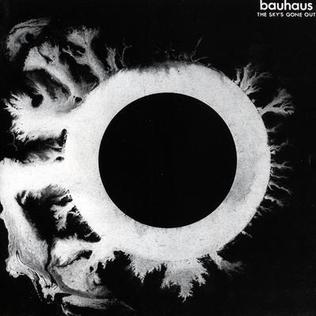
Call it a cop out or the sign of an incredibly dedicated fan, but here we are again with another review of a Bauhaus album. This time, I will talk about the third full studio album offered by the group in 1982, The Sky's Gone Out.
Album cover art for The Sky's Gone Out
Other reviewers before me have given this album a positive enough review but dock it for 1) being much more dark and negative than the preceding studio album, Mask, and 2) being an odd mix of individual songs that stand out on their own but don't really connect to make a complete sounding and feeling album.
From my perspective, yes, The Sky's Gone Out is much darker than my favorite Bauhaus album, Mask. But hey, we goth-y sorts love that kind of thing, right? Yes, yes we do. And I think there is something to be said about albums with strong, individual songs, that don't necessarily flow into one another. Not everything needs to be a concept album, telling a story from start to finish through several songs.
Bauhaus. Left to right: David J (bass), Kevin Haskins (drums), Peter Murphy (vocals), Daniel Ash (guitar)
The Sky's Gone Out opens with a cover of Brian Eno's "Third Uncle." Admittedly, I hadn't gotten into Brian Eno until more recently (I certainly heard this cover well before hearing the original). I also admit to being incredibly picky about covers. Most covers, in my mind, are sub par at best. There are the rare few that are decent, but the original is still better. And then there's the category this cover falls under - covers that are just as good if not BETTER than the original. I like Brian Eno's work, but I actually love the Bauhaus cover more than the original. Then again, I think I like every Bauhaus cover more than the original song...though the cover for "Ziggy Stardust" and David Bowie's original are on roughly equal footing for me.
The second track, "Silent Hedges," is a song I always enjoy seeing performed. The passion that comes through, the constant point to the ground to symbolize "the beautiful downgrade" and "going to Hell again." It's such a wonderful song and has been a favorite of mine for a long time. And for those that like all the gloom and doom, tell me a lyric like "Burning the private paradise of dreams/madness at the hands of the electric clock/what happens when the intoxication of success has evaporated?" doesn't send chills down your spine? Easily my favorite part of the song.
Peter Murphy at some point in his solo career (probably in the 80s?)
The third track is "In The Night." For whatever reason, I didn't used to give this song any attention. I'd often skip it. Then a couple weeks ago, I just listened to it fully. And I felt like I got slapped in the face by reality and woke up to something sensational. The song starts off relatively slow and transitions into a song more similar to post-punk's predecessor genre - punk. The schizophrenic nature of this song with some beautiful (yet dark) lyrics makes this such a great track. Should Peter Murphy ever play this one live, I imagine the entire audience, regardless of whether they know the lyrics to this one, would go absolutely bat shit crazy. The likelihood of this happening is probably slim to none, but I can only hope I'm there for that moment.
Skipping over the fourth and fifth tracks (the fifth track being a special number with a good one minute plus at the end repeating "we love our audience!" which could very well be a nod to all the critics out there that consistently gave Bauhaus poor reviews), we come to "The Three Shadows" parts 1, 2, and 3. The first part is a haunting instrumental. I think Peter Murphy opened with this one when I saw him at the Moody Theater here in Austin in November 2011 (I know it was one of the three parts and most sources say it was part 2, but I don't remember him singing any lyrics and the intro music was very long while part 2 doesn't have all that much a musical intro before the lyrics begin). Part 1, to me, is just one of those songs that sends chills down your spine (I'm listening to it as I write this part, and sure enough...chills down the spine). Some parts of this song actually remind me of the more musical elements in some of Peter Murphy's solo work (perhaps a hint on some work on Dust and Holy Smoke). You want a quintessential goth song? Here it is.
Part 2 is, according to Peter Murphy in recent interviews, a song he wrote and composed wholly (recall, most Bauhaus songs he had parts in writing lyrics and music, but he was not the predominating force). This song has the feel of something from the 1800s. Some dapper gentleman, sitting in a bar, sipping at whiskey, thinking of some prostitute. I don't know. Maybe that's a little too literal a reading of the starting lyrics. But it's almost a statement, to me, of the death of the noble gentleman and how the speaker of the song is pulled into the middle of the rat race but will always exist. I openly admit I'm not so great at interpreting song lyrics. But, there is something exquisitely dark in this song that I can't fully put my finger on.
I will finish with discussing "All We Ever Wanted Was Everything." This is a fairly simple song musically consisting of just guitar (mostly acoustic until about half way through), some drums (half way into the song), bass/violin (I think the recording uses a bass while it is performed live with a violin), and vocals. As Peter Murphy explained to the crowd during the Mr. Moonlight tour at I believe Dallas (maybe Austin? I forget), this song was inspired (musically) by the first chords he learned to play on guitar and that he wanted to write lyrics around that. As for the song's meaning, I interpret the lyrics as a statement of the beginning days for the band: "All we ever wanted was everything / all we ever got was cold / get up, eat jelly / sandwich bars and barbwire / squash every week into a day...oh to be the cream." To me, it all began as this desire to have everything - the fame, fortune, happiness, acclaim, fans, etc. But, as with all new things, you start at nothing. And in basically creating a new music genre, you have the added difficulty in having to sell that vision to people. So, you may want everything, but you end up getting only cold. You're poor, so you eat PB&J and the barbwire bitter words of critics (there are pictures of, if I remember correctly, Kevin Haskins ripping newspaper reviews of Bauhaus albums to shreds because the reviews were incredibly negative). And you have to work hard, move fast, and effectively squash a week of life into a day. And then there's still that dream fantasy..."oh to be the cream." Effectively, oh to be the best part of it all. The richness, the decadence, the cream.
Peter Murphy again, but sporting blonde hair! This was probably late 80s to early 90s when the Deep album was released
On the whole, I'll agree with the reviewers I mentioned earlier. Yes, this is a dark album. It is dark musically, and it is dark lyrically. Its delivery leaves no mistake to be made about first impressions. There is evil and nastiness in the world and this album points it out to you. Additionally, yes, the songs don't exactly flow together perfectly. The final song on the album, "Exquisite Corpse," is probably the most schizophrenic song I have ever heard, it itself not flowing perfectly from one section to the next. But, as I also said, I think there is something to be said about an album of strong songs that points out, perhaps, the disconnected nature of life and human interaction. While still not my favorite Bauhaus album, it is certainly a sensational trip. I don't think I could give just one answer for the most gothic album, but this would certainly make the list of albums that defines our little subculture.
Rating: 4.5 out of 5 (just because the reggae part in "Exquisite Corpse" ruins that amazingly chilling song...I love the guitar work in that one, but man the reggae part...just no)
It's been a while since I last mused over an album. I finally got around to buying one of my favorite Curxshadows albums, The Mystery of the Whisper.
The cover to the 2CD re-issue with their breakthrough album, The Mystery of the Whisper, and a rare EP, Until the Voices Fade...
Depending who you talk to, The Cruxshadows are considered Dark Electro, Goth Rock, Dark Wave, etc. Basically, we'll go with some form of modernized creepy pasta and call it a day (I'm not much into debating what genre something is and isn't. They aren't country and that's good enough for me).
Cruxshadows formed in 1992 with Rogue, Sean Flanagan, and Tim Curry (no, not THE Time Curry of Rocky Horror fame. I know, I was also slightly disappointed) in Florida. 1996 saw the release of Telemetry of a Fallen Angel which produced their first single, Marilyn, My Bitterness, and brought some modest attention to the group. The Mystery of the Sound came out in 1999. Over time, several changes have occurred in the line up with Rogue remaining as the only original member. They have, until recent times, been a band that has spent more time touring each year than actually sitting at home doing more domestic sorts of things. Based on the Twitter account for the band run by Rogue, it seems a new album is in the mix.
The current line-up for The Cruxshadows. I don't know them well enough to say who is who, but Rogue is the third from the left and his wife is one of the women. I know, so helpful.
Now, I do want to mention some things I find really cool about Rogue. First, he is the heir to the Du Pont legacy. You know, Du Pont. Those guys that seem to make everything chemical related. Yeah, he's part of that. Instead of taking a back seat to life and living the rich life, Rogue actually worked hard in school being one of those smart kids, founded a poetry club, lettered in something, competed nationally in speech and debate tournaments, and was an officer in the JROTC, among other things. He then went on to study art and music at FSU, graduating magna cum laude. Regardless of whether you like him and his band or not, you must admit he kind of defines the whole "overachiever" thing.
Rogue. He actually isn't as angry as he looks in this photo.
So, all that said, let's get to the album. This is an album with some references to Egyptian lore (but only a few). The album starts with the mostly instrumental Isis & Osiris (Life/Death). It has a nice vibe, good instrumentation, and sets the tone for the album. Being an instrumental track with some kind of singing in the background (not sure if it's supposed to be based on the language of the ancient Egyptians or what), there isn't much to say.
The next track, Cruelty, is perhaps one of my favorites from the band. The intro is a bit electronic meets organ. Great way to start the song as it's very mysterious. I don't like to delve much into song meanings as I still contend songs mean different things for different people. It is possible this is one of the angst-y sorts of songs as the chorus goes, in part: "Cruelty and consequence cannot eliminate this relevance, your selfishness, your hatefulness cannot take away my innocence from me." Regardless of the meaning, it's a song with a good beat and music, if nothing else. Check it out for yourself. And no, I have no idea what's going on in the video. And yes, Rogue's hair is kind of distracting:
Next is Leave Me Alone. Yes, perhaps another angst-y song, at best. But it seems to speak to a dilemma the Goth crowd often faces. Gallivant in public wearing all black and people stare at you and glare at your back. The character in this song seems to be speaking to someone else, possibly a love interest or just a friend. They're trying to get this second person to leave them alone because they are "a freak" and so forth. It isn't necessarily that the main character really wants this person to leave them alone so much as it may be "Hey, understand, the world thinks I'm a freak and they all stare at me wherever I go." Good song to listen to, though I don't necessarily agree with the slant. We all get weird looks from people, so why encourage a possible friend/romance away because you, like everyone else, get odd looks from people?
Most of the remaining songs sound similar enough (except Sympathy (For Tomorrow) which is focused more on piano and violin with cleaner vocals). I can understand why The Cruxshadows may not be in the libraries of every person with a taste for creepy pasta. The lyrics tend to be very simplistic (at least on this early album) and don't do much for fending off certain Goth stereotypes. I listen to this album more for the music than the words.
Rating: 4 out of 5 (like I said, good music, but the lyrics leave more to be desired)
More information: Official Cruxshadows Website