Thursday, May 16, 2013

Music Review: Bauhaus - The Sky's Gone Out

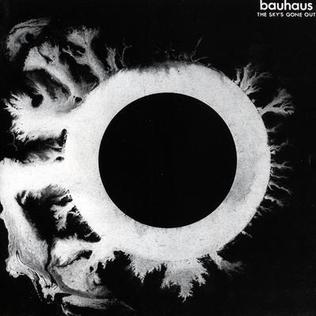
Call it a cop out or the sign of an incredibly dedicated fan, but here we are again with another review of a Bauhaus album. This time, I will talk about the third full studio album offered by the group in 1982, The Sky's Gone Out.

Album cover art for The Sky's Gone Out
Other reviewers before me have given this album a positive enough review but dock it for 1) being much more dark and negative than the preceding studio album, Mask, and 2) being an odd mix of individual songs that stand out on their own but don't really connect to make a complete sounding and feeling album.

From my perspective, yes, The Sky's Gone Out is much darker than my favorite Bauhaus album, Mask. But hey, we goth-y sorts love that kind of thing, right? Yes, yes we do. And I think there is something to be said about albums with strong, individual songs, that don't necessarily flow into one another. Not everything needs to be a concept album, telling a story from start to finish through several songs.

Bauhaus. Left to right: David J (bass), Kevin Haskins (drums), Peter Murphy (vocals), Daniel Ash (guitar)
The Sky's Gone Out opens with a cover of Brian Eno's "Third Uncle." Admittedly, I hadn't gotten into Brian Eno until more recently (I certainly heard this cover well before hearing the original). I also admit to being incredibly picky about covers. Most covers, in my mind, are sub par at best. There are the rare few that are decent, but the original is still better. And then there's the category this cover falls under - covers that are just as good if not BETTER than the original. I like Brian Eno's work, but I actually love the Bauhaus cover more than the original. Then again, I think I like every Bauhaus cover more than the original song...though the cover for "Ziggy Stardust" and David Bowie's original are on roughly equal footing for me.

The second track, "Silent Hedges," is a song I always enjoy seeing performed. The passion that comes through, the constant point to the ground to symbolize "the beautiful downgrade" and "going to Hell again." It's such a wonderful song and has been a favorite of mine for a long time. And for those that like all the gloom and doom, tell me a lyric like "Burning the private paradise of dreams/madness at the hands of the electric clock/what happens when the intoxication of success has evaporated?" doesn't send chills down your spine? Easily my favorite part of the song.

Peter Murphy at some point in his solo career (probably in the 80s?)
The third track is "In The Night." For whatever reason, I didn't used to give this song any attention. I'd often skip it. Then a couple weeks ago, I just listened to it fully. And I felt like I got slapped in the face by reality and woke up to something sensational. The song starts off relatively slow and transitions into a song more similar to post-punk's predecessor genre - punk. The schizophrenic nature of this song with some beautiful (yet dark) lyrics makes this such a great track. Should Peter Murphy ever play this one live, I imagine the entire audience, regardless of whether they know the lyrics to this one, would go absolutely bat shit crazy. The likelihood of this happening is probably slim to none, but I can only hope I'm there for that moment.

Skipping over the fourth and fifth tracks (the fifth track being a special number with a good one minute plus at the end repeating "we love our audience!" which could very well be a nod to all the critics out there that consistently gave Bauhaus poor reviews), we come to "The Three Shadows" parts 1, 2, and 3. The first part is a haunting instrumental. I think Peter Murphy opened with this one when I saw him at the Moody Theater here in Austin in November 2011 (I know it was one of the three parts and most sources say it was part 2, but I don't remember him singing any lyrics and the intro music was very long while part 2 doesn't have all that much a musical intro before the lyrics begin). Part 1, to me, is just one of those songs that sends chills down your spine (I'm listening to it as I write this part, and sure enough...chills down the spine). Some parts of this song actually remind me of the more musical elements in some of Peter Murphy's solo work (perhaps a hint on some work on Dust and Holy Smoke). You want a quintessential goth song? Here it is.


Part 2 is, according to Peter Murphy in recent interviews, a song he wrote and composed wholly (recall, most Bauhaus songs he had parts in writing lyrics and music, but he was not the predominating force). This song has the feel of something from the 1800s. Some dapper gentleman, sitting in a bar, sipping at whiskey, thinking of some prostitute. I don't know. Maybe that's a little too literal a reading of the starting lyrics. But it's almost a statement, to me, of the death of the noble gentleman and how the speaker of the song is pulled into the middle of the rat race but will always exist. I openly admit I'm not so great at interpreting song lyrics. But, there is something exquisitely dark in this song that I can't fully put my finger on.

I will finish with discussing "All We Ever Wanted Was Everything." This is a fairly simple song musically consisting of just guitar (mostly acoustic until about half way through), some drums (half way into the song), bass/violin (I think the recording uses a bass while it is performed live with a violin), and vocals. As Peter Murphy explained to the crowd during the Mr. Moonlight tour at I believe Dallas (maybe Austin? I forget), this song was inspired (musically) by the first chords he learned to play on guitar and that he wanted to write lyrics around that. As for the song's meaning, I interpret the lyrics as a statement of the beginning days for the band: "All we ever wanted was everything / all we ever got was cold / get up, eat jelly / sandwich bars and barbwire / squash every week into a day...oh to be the cream." To me, it all began as this desire to have everything - the fame, fortune, happiness, acclaim, fans, etc. But, as with all new things, you start at nothing. And in basically creating a new music genre, you have the added difficulty in having to sell that vision to people. So, you may want everything, but you end up getting only cold. You're poor, so you eat PB&J and the barbwire bitter words of critics (there are pictures of, if I remember correctly, Kevin Haskins ripping newspaper reviews of Bauhaus albums to shreds because the reviews were incredibly negative). And you have to work hard, move fast, and effectively squash a week of life into a day. And then there's still that dream fantasy..."oh to be the cream." Effectively, oh to be the best part of it all. The richness, the decadence, the cream.

Peter Murphy again, but sporting blonde hair! This was probably late 80s to early 90s when the Deep album was released
On the whole, I'll agree with the reviewers I mentioned earlier. Yes, this is a dark album. It is dark musically, and it is dark lyrically. Its delivery leaves no mistake to be made about first impressions. There is evil and nastiness in the world and this album points it out to you. Additionally, yes, the songs don't exactly flow together perfectly. The final song on the album, "Exquisite Corpse," is probably the most schizophrenic song I have ever heard, it itself not flowing perfectly from one section to the next. But, as I also said, I think there is something to be said about an album of strong songs that points out, perhaps, the disconnected nature of life and human interaction. While still not my favorite Bauhaus album, it is certainly a sensational trip. I don't think I could give just one answer for the most gothic album, but this would certainly make the list of albums that defines our little subculture.

Rating: 4.5 out of 5 (just because the reggae part in "Exquisite Corpse" ruins that amazingly chilling song...I love the guitar work in that one, but man the reggae part...just no)

More information: Official Site of Bauhaus Official Site of Peter Murphy

Thursday, May 9, 2013

Concert Review: The Bellwether Syndicate 4/20/13

Back on April 20th as part of Convergence XIX (alt.net's large party of all things goth that travels from city to city every year for the last 19 years) in Austin, I had the pleasure of seeing The Bellwether Syndicate perform.

The Bellwether Syndicate. Left to right: Mike Skull (bass guitar), Scary Lady Sarah Rose (guitar, backing vocals), William Faith (vocals, guitar), Philly Peroxide (keyboards, percussion)
Many of you reading this have heard of William Faith. He has been an instrumental figure in much of the goth music scene having been part of Rozz Williams' Christian Death, Shadow project, Mephisto Walz, a one-off performance with the Sex Gang Children, and, of course, Faith and the Muse (that one seems fairly obvious). Faith returns with a new kickstarter project (literally) with Chicago's infamous DJ Scary Lady Sarah Rose, The Bellwether Syndicate.

Currently, the group have only released on their own Bellwether Underground label an EP of five songs entitled the Night Watch EP. Without turning this into a music review, I will go so far as to say the first three tracks on the EP are similar to each other, fast paced deathrock influenced tracks that are catchy as can be. The fourth track is very different, a bit slower, yet still impressive. The final track showcases both Sarah Rose's guitar work and vocals. It's also quite a bit different from the other four tracks, but demonstrates the immense talent the group brings to the table.

For the performance at Convergence XIX (which was apparently the third or fourth live performance for the group ever), the group began with track one from the new EP, "All Fire." Mind you, I was excited as could be for this performance because we're talking William Faith here. The way all four members took the stage was telling in of itself. They were humble. Smiles all around, ready to have a great time sharing their music with us. No air of arrogance like they were entitled to everything. Just good nature fun ready to take hold. Once they started into "All Fire," I was hooked. It was some small fortune that the dance floor was a bit packed, for if it hadn't been, I would have been the definition of "bat shit crazy."

Following "All Fire" came my favorite off the EP, "Night Watch." The song is just incredibly catchy. What I find so interesting in the manner with which Bellwether Syndicate performs is that the music and words give off plenty of energy. Playing guitar and singing, both William Faith and Sarah Rose are a little stuck with where they're at on the stage. Yet, you could tell both were incredibly into their performances. They wanted to be there. Philly Peroxide, while in the back, was still a strong force to be reckoned with (though similar to Faith and Rose, he was a bit stuck where he was while performing on the keyboards). Mike Skull was about the most mobile of the four, moving a few paces here and there while absolutely rocking out on the bass guitar. By this point I was fully sold.

A photo of Bellwether Syndicate roughly a week later at the Whitby Gothic Festival
"101 Go" was next, another solid and catchy song. From here, Faith took a moment to thank everyone for coming and for allowing Bellwether Syndicate to be part of C19. He then introduced the next song as one in the memory of a good friend and that we truly all are souls in isolation. That's right, a cover often done with Faith and the Muse, the Chameleon's "Soul in Isolation." Often, I am very critical of cover songs. Rarely do I find ones I enjoy. Even rarer are the ones that are just as good, and sometimes even better, than the original. This is an instance where I think the cover might just be a tiny bit better than the original and I personally love the Chameleons! Suffice to say, we all went a little bat shit crazy by this point.

The group finished their set with track four off the EP, "Translucent." Personally, I would have loved for the set to go on all night. Five songs simply was not enough. Once the group left the stage, I quickly snagged the one and only copy of the setlist with the hope of meeting the band members and getting it signed.

Allow me to say that William Faith is probably one of the nicest and most delightful people I have ever had the pleasure to meet. You saw all those bands I told you he was part of? Let's just say this man, much like Peter Murphy, is a gigantic name in the goth scene. He could be arrogant and rude and no one would think twice of it. Instead, he was very nice, glad I enjoyed the show, happy to be there, etc. He also happily signed my setlist.

Additionally, Scary Lady Sarah Rose is another wonderful person. She seemed almost confused as to why I'd want her autograph! After signing the setlist, we talked some about the show. I told her she did a fantastic job (which I thought she did, and she seemed so happy to be on stage!). She was then telling me how she was actually incredibly nervous and how this was about her third time ever to perform in front of an audience like this. She also mentioned how the fifth track on the EP was one where she sang and played guitar, but that they didn't play it that night since it's a bit hard to sing and play guitar at the same time. I was just amazed at how chill and honest she was about everything. I thanked her again and told her they should come back to Austin again soon.


All in all, five songs is an incredibly short set. But, to be that catchy and engaged in such a short period of time is a talent alone. And to play wonderful music, too!? That night I became a big fan of this new project and have since found myself getting more into Faith and the Muse. I really do hope they return to Austin soon with even more music to share. There is something truly special in this group and I'm very happy to have witnessed it during C19.


Rating: 5 of 5

More information: Official site of the Bellwether Syndicate

Music Re-Review: Bauhaus - Go Away White

A little over a year ago, I wrote a review on the last offering from legendary post-punk band, Bauhaus, 2008's Go Away White. (You can read that review here)

Since that review, I have listened to Go Away White a bit more and find my view of the album to have changed a bit. So, I felt a re-review was of the essence to explain my new thoughts on the album and perhaps a little of what has changed my view on it.

Bauhaus, as they looked around the time of Go Away White. Left to right: Daniel Ash (guitar, backing vocals), Kevin Haskins (drums), Peter Murphy (vocals, other instruments on occasion), David J (bass guitar, backing vocals)

I won't review the history of the band again. Suffice to say, the band has undergone three major periods - the original period from 1978 to 1983 where the majority of the music was written, recorded, and performed, the 1998/1999 Resurrection reunion tour which spurred the Gotham CD/DVD but no new material from the group, and the 2005-2008 period that resulted in Go Away White as the final offering from the group and minimal touring opening for Nine Inch Nails (the former in 2008, the latter in 2005/2006).

Recently, Peter Murphy has undergone a massive tour to celebrate 35 years of Bauhaus existing. In the past, he would play a few Bauhaus songs in his solo sets as they fit in, providing an indulging experience for fans who weren't quite expecting the rare treat. But, 35 years and the kind of influence, albeit rather underground, that Bauhaus has garnered shouldn't go without notice. So, the tour, dubbed the Mr. Moonlight Tour, features Peter Murphy with his solo work band members playing a full Bauhaus setlist. There is no "Cuts You Up," no "I'll Fall With Your Knife," and certainly no "Peace to Each." Just a divine combination of the Bauhaus hits every fan knows and loves and lesser known beauties that only the most extreme of fans would know all the words to.

Peter Murphy and the ever talented Mark Gemini Thwaite on guitar at the Granada Theater in Dallas during the Mr. Moonlight Tour. I'm also 99.9% sure this photo was taken by Bill Ellison at the Granada.

I will endeavor to write a concert review surrounding this tour at a later time. The point I am getting at here, however, is that on this tour, certain songs from Go Away White have made their appearances. And it is in this context of a full Bauhaus set, hearing some of those songs for the first time live (first time for me), that something has clicked into place.

Years ago, the very first time I saw Peter Murphy perform (June 2009, Emo's outdoor stage in Austin on 6th street and Red River) he busted out "Too Much 21st Century." It struck me as odd that he needed a piece of paper with the lyrics on it. After all, the album had been out for a year and was relatively fresh. Of course, in retrospect, I perhaps take for granted the fact that a person like Peter Murphy with such a prolific career and countless lyrics remembers the vast majority so well. And if he wasn't planning to play those songs every night, it becomes easy to see how someone wouldn't necessarily remember all the words and perfectly.

As I have remarked and has been mentioned in interviews with the band members, Go Away White draws many different influences that differ vastly from the initial influences that spurned previous albums. Go Away White wasn't exactly intended to be the continuation of the band. It wasn't meant as the big follow-up, years later, to Burning From the Inside. Instead, it was more a meeting of the minds at a middle ground, a junction that brought in their current places in their careers. After all, if you listen to any project from the four following Bauhaus, none really carried the same sort of sound or purpose as Bauhaus.

In "Too Much 21st Century," there's an argument proposed that everything in the 21st century way of living is about wanting more than what you have. Want a better actress, better singer, more money, etc. Instead of being thankful for what you do have, it isn't enough. And there is truth to this argument, I believe. Today's world is incredibly fast paced and often your best just isn't good enough. While I first found this song to be rather simplistic, I now feel there is a certain beauty in that simplicity.

Love and Rockets, the major project of David J, Kevin Haskins, and Daniel Ash post-Bauhaus
The second song on the album, "Adrenalin," was one I never gave much thought to. The lyrics basically describe what adrenalin can do to your body (kickstart your heart, make the finish just the start, etc.). However, seeing the song live in Houston on the Mr. Moonlight Tour and seeing the energy Peter Murphy put into the song, it just instantly grew on me that night. Again, the lyrics are not like the older Bauhaus songs. They aren't poetic or cryptic. They're really there at a more surface level. But something in the music and the rawness of the performance just makes this song incredible.

In the interest of sparing some reading, I won't go over every track on the album. There are still those, like "Saved," that I don't much care for even still. Instead, I will talk some on the last two songs I greatly enjoy from this album.

Track 4, "International Bulletproof Talent," reminds me of some of those old-timey spy movies. Not the ones you take seriously like James Bond, but the sort with the cheesy music and large hats and coats. This isn't to say this song is cheesy and shouldn't be taken with some kind of seriousness. But just to say that the music reminds of that sort of thing, really. It isn't much, and maybe this is a cop-out, but I really like how the music and vocals mesh on this track. Just take my word on it that it's a good one.

The final track I will talk about is perhaps my favorite from the album. "Endless Summer of the Damned" is perhaps the one song on this album that nods back to what Bauhaus's style used to be. I don't mean to say this fits along exactly beside "Bela Lugosi's Dead" or "Terror Couple Kill Colonel," but there are some beautiful lyrics to this song that I simply don't follow. A surface level reading could indicate that this is a commentary against global warming (i.e. "the ultra violet's violent" could be something to suggest that the sun has become more harsh and is harming us), but I suspicion there's more to this than the surface level suggests. Basically, my new found love for this track is based off of seeing it performed in Dallas on the Mr. Moonlight Tour. I distinctly remember getting goosebumps during this song, wondering what it was. I knew it must of been off of Go Away White and when I caught the lyrics of "the endless summer of the damned," I knew it was this song. But my goodness was it amazing! Perhaps what caught me was not just the power in the song itself, but seeing everyone on stage jumping to it and rocking out. There was something very oddly personal and inviting in that moment. I felt very connected to the performance at that moment (not to say I wasn't connected before, but more so).

Dalis Car, the rocky collaboration between Peter Murphy and ex-Japan bassist Mick Karn that spurned one full album in the early 80s, a much too short EP in the mid-2000s, and showed Peter Murphy that he had what it took to be a solo musician, capable of writing songs and music of his own
All in all, this still isn't my favorite Bauhaus album. It may very well still be my least favorite (though it is at least gaining ground on Burning From the Inside). But as I listen to it more and understand the state of mind all four members were in at the time, I begin to appreciate the album more and more for what it is. The members often describe the writing and recording of this album as spontaneous. First takes were used as the final cuts. The album was wrapped in 18 days. Much as every breakup of the band was essentially spontaneous, it should be fitting that their last contribution together would be as well. Peter Murphy has also said how he felt the timing was right for this to be the end. He had tried a few times to bring the band together again with no avail. He felt the other three were just tired and could no longer keep up. Perhaps on the outset, those words seem very harsh, but I believe there is truth to them. Merely ask yourself who the driving force of the band was. Who brought them together repeatedly? Who has had the longest and most prolific career? Who is still going strong? Peter Murphy. Sure, this may not be the end many long standing fans of the band were hoping for. In honesty, is it fair to say any of us were even hoping for an end? Probably not. But, all things taken, I feel this may have been the best end for the band.


Rating: 4 of 5

More information: Official Bauhaus website, Official site of Peter Murphy

Thursday, June 14, 2012

Music Review: The Cruxshadows - The Mystery of the Whisper

It's been a while since I last mused over an album. I finally got around to buying one of my favorite Curxshadows albums, The Mystery of the Whisper.

The cover to the 2CD re-issue with their breakthrough album, The Mystery of the Whisper, and a rare EP, Until the Voices Fade...
Depending who you talk to, The Cruxshadows are considered Dark Electro, Goth Rock, Dark Wave, etc. Basically, we'll go with some form of modernized creepy pasta and call it a day (I'm not much into debating what genre something is and isn't. They aren't country and that's good enough for me).

Cruxshadows formed in 1992 with Rogue, Sean Flanagan, and Tim Curry (no, not THE Time Curry of Rocky Horror fame. I know, I was also slightly disappointed) in Florida. 1996 saw the release of Telemetry of a Fallen Angel which produced their first single, Marilyn, My Bitterness, and brought some modest attention to the group. The Mystery of the Sound came out in 1999. Over time, several changes have occurred in the line up with Rogue remaining as the only original member. They have, until recent times, been a band that has spent more time touring each year than actually sitting at home doing more domestic sorts of things. Based on the Twitter account for the band run by Rogue, it seems a new album is in the mix.

The current line-up for The Cruxshadows. I don't know them well enough to say who is who, but Rogue is the third from the left and his wife is one of the women. I know, so helpful.
Now, I do want to mention some things I find really cool about Rogue. First, he is the heir to the Du Pont legacy. You know, Du Pont. Those guys that seem to make everything chemical related. Yeah, he's part of that. Instead of taking a back seat to life and living the rich life, Rogue actually worked hard in school being one of those smart kids, founded a poetry club, lettered in something, competed nationally in speech and debate tournaments, and was an officer in the JROTC, among other things. He then went on to study art and music at FSU, graduating magna cum laude. Regardless of whether you like him and his band or not, you must admit he kind of defines the whole "overachiever" thing.

Rogue. He actually isn't as angry as he looks in this photo.
So, all that said, let's get to the album. This is an album with some references to Egyptian lore (but only a few). The album starts with the mostly instrumental Isis & Osiris (Life/Death). It has a nice vibe, good instrumentation, and sets the tone for the album. Being an instrumental track with some kind of singing in the background (not sure if it's supposed to be based on the language of the ancient Egyptians or what), there isn't much to say.

The next track, Cruelty, is perhaps one of my favorites from the band. The intro is a bit electronic meets organ. Great way to start the song as it's very mysterious. I don't like to delve much into song meanings as I still contend songs mean different things for different people. It is possible this is one of the angst-y sorts of songs as the chorus goes, in part: "Cruelty and consequence cannot eliminate this relevance, your selfishness, your hatefulness cannot take away my innocence from me." Regardless of the meaning, it's a song with a good beat and music, if nothing else. Check it out for yourself. And no, I have no idea what's going on in the video. And yes, Rogue's hair is kind of distracting:


Next is Leave Me Alone. Yes, perhaps another angst-y song, at best. But it seems to speak to a dilemma the Goth crowd often faces. Gallivant in public wearing all black and people stare at you and glare at your back. The character in this song seems to be speaking to someone else, possibly a love interest or just a friend. They're trying to get this second person to leave them alone because they are "a freak" and so forth. It isn't necessarily that the main character really wants this person to leave them alone so much as it may be "Hey, understand, the world thinks I'm a freak and they all stare at me wherever I go." Good song to listen to, though I don't necessarily agree with the slant. We all get weird looks from people, so why encourage a possible friend/romance away because you, like everyone else, get odd looks from people?

Most of the remaining songs sound similar enough (except Sympathy (For Tomorrow) which is focused more on piano and violin with cleaner vocals). I can understand why The Cruxshadows may not be in the libraries of every person with a taste for creepy pasta. The lyrics tend to be very simplistic (at least on this early album) and don't do much for fending off certain Goth stereotypes. I listen to this album more for the music than the words.


Rating: 4 out of 5 (like I said, good music, but the lyrics leave more to be desired)
More information: Official Cruxshadows Website

Saturday, June 2, 2012

Concert Review: David J 6/1/12

Last night (and early evening), I saw one fourth of Bauhaus - Mr. David J! He was in town (randomly, apparently) and decided to promote his new album, "Not Long For This World." I saw him first around 7pm at Cheapo Records where he did an in-store performance (to like ten people) and then stayed after for autographs and pictures. Later that night, he was at Elysium playing a slightly longer set and breaking out some classic favorites.

David J playing bass for Bauhaus during the band's last round of reunion
David J was one of the founding members of post-punk band Bauhaus in 1978. The band went on to release several albums and singles and garner a deep, albeit underground, following. The band originally disbanded in 1983, presumably over tensions of David J, Daniel Ash, and Kevin Haskins recording most of "Burning From the Inside" without singer Peter Murphy (he had pneumonia at the time). Bauhaus would later return in 1998 for the Resurrection reunion tour, only to disband again. Finally, Bauhaus returned with 2006's "Go Away White" and some marginal touring with Nine Inch Nails over the next couple of years before disbanding for seems like the final time.

In the interim periods of Bauhaus's rises and falls, David J went on to form bands such as the highly experimental Tones on Tail with Bauhaus guitarist Daniel Ash and roadie Bauhaus roadie Glenn Camping. Once that fell through, J and Ash rejoined with Bauhaus drummer (and David's younger brother), Kevin Haskins to form the fairly popular Love and Rockets. Both David J and Daniel Ash released solo material over time as well.

Love and Rockets (left to right: Kevin Haskins, David J, Daniel Ash)
At Cheapo Records, David J only played a handful of songs, most from his solo work. He did play "Sweet FA" and "No New Tale to Tell" from Love and Rockets. It was very clear that all of us watching him were there because he was David J of Bauhaus. None of us knew the lyrics to his solo material. Heck, most of us didn't know the words to his Love and Rocket's material either! (I know the lyrics to "No New Tale to Tell," but not "Sweet FA" as I don't listen to Love and Rockets often). However, he was in good spirits and having fun with things. Because David J doesn't perform often, he himself doesn't have all the lyrics memorized well (even those of his own songs) and needs a lyric book (which he forgot over at Elysium). This prompted lots of joking about his age and his admitting to have skipped different lines and added in others (not like any of us would have known otherwise, haha!). Afterwards, David J talked with us, signed autographs, and took pictures. I got my "On Glass" 12" signed and a couple of his solo albums on CD (they're hard to find, which doesn't help matters any with trying to follow his solo work).

At Elysium, the story continued. He had his song book this time with the lyrics (only removing it to play "No New Tale to Tell" again and both Bauhaus songs). He was much quieter this time, not talking to the audience as much (then again, many people were being very rude and talking loudly as he performed). Overall, the performance was great. He did a new version of "No New Tale to Tell" with Adrian H and the Wounds that I wasn't terribly crazy about and the version of "Bela Lugosi's Dead" that he ended the night with was odd. He had great atmosphere for that one (took the lamp from his lyric book stand and put it under his face to imitate Peter Murphy's putting his face in a white light and also draped his jacket like a cloak). However, David J commonly likes to add random lyrics at the end of the song which don't necessarily go with it. Additionally, the drawn out "Ooooooohhhhhhh Bellllllllllaaaaaaaaa" parts were completely removed, which are my favorite parts of the song. Good effort, but I'd much rather listen to Peter Murphy's mash-up of "A Strange Kind of Love" and "Bela Lugosi's Dead" that he commonly does at shows.

On the whole, David J is a very humble, funny, delightful man. This set of performances has actually perked my interest in his solo work (I tend to not listen to it as the little things I had heard I didn't much care for). I now believe a second listen is in order. This also puts me at seeing one half of Bauhaus in some form or another. I wish I could have seen them during the last reunion. May not have been anything like they were back in their heyday, but I'm sure it was great.


Setlist from Elysium:

Dagger in the Well
Crocodile Tears and the Velvet Cosh
Shelf Life
Rain Bird
If You Could Read My Mine
Spalding Gray
Who Killed Mr. Moonlight?
Silver for Gold
Not Long For This World
Dog-End of a Day Gone By

ENCORE

No New Tale to Tell
Alabama Song
Bela Lugosi's Dead

Tuesday, May 22, 2012

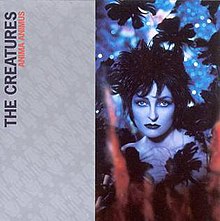
Music Review: The Creatures - Anima Animus

This week's Music Review looks at one portion of the great Siouxsie Sioux's music career, the experimental rock side project with fellow Banshees member Budgie, The Creatures.

Siouxsie Sioux and Budgie of The Creatures

The Creatures was a side project Sioux and Budgie ventured into in 1981 during the recording of the Juju album from their main band, Siouxsie and the Banshees. By accident, the two discovered that having only vocals and drums to the track "But Not Them" was an amazing combination. This led to the first Creatures EP, Wild Things. The Creatures was always an on and off again side project for the two as their primary focus was on Siouxsie and the Banshees until the main group's big split in 1996. After that, The Creatures released two more albums, Anima Animus and Hai! The Banshees went on to reunite in 2002 for a massive tour before splitting again. With 2007 seeing Sioux and Budgie divorce, all musical partnership between the two ended, effectively marking the end of Siouxsie and the Banshees and The Creatures forever (or at least until they are able to reconcile).

Anima Animus, released in 1999, may have been the second to last Creatures album, but it is most likely my favorite Creatures album. It is also, I believe, the one from which the most songs appeared on the Dreamshow DVD from 2004's performance at the Royal Albert Hall (I'm not going to count, so someone may correct me if they wish).


The album title refers back to an idea from Carl Jung regarding transgender: the woman inside the man, the man inside the woman. I suppose you could interpret some lyrics in the songs to relate back to this, but given that the album had two prior names before it was decided as Anima Animus, I'm not sure if the intent of Sioux and Budgie was to relate songs to title.

The starting track, "2nd Floor," has an urgency to it. And is very catchy. The phrases Sioux sings are really short, leaving the track to be more focused on the techno-esque music (heavier on the -esque than the techno). This also happened to be the first single from the album. I'm not sure if this is my favorite from the album, but it's damn close if it isn't! Here is the music video for the song:


"Disconnected" is another great song with really cool instrumentation. What I mean here is that in certain parts, after Siouxsie finishes some lyrics, the music emphasizes those pauses (ex. right before the lyrics "And when you're feeling glad/Alaska shows her greedy hand").

I'll skip to the end as I don't have much to say about the rest of the album. Don't get me wrong. This isn't me saying the remainder of the album is mediocre or even bad. Several of those songs are worth a good listen ("Say," "I Was Me," "Prettiest Thing," and "Exterminating Angel," to name my big favorites). Instead, I want to look a little into "Don't go to Sleep Without Me."

This is by far the creepiest song. Is it bad? Far from it. But could you imagine just jamming along to the entire album with strong drum parts and a massive sense of urgency only to reach the final song where a slow, eerie guitar in the background accompanies Siouxsie essentially whispering in your ear? Yeah, a little creepy. But the complete change from the rest of the album is a pleasant deviation and really genius, in my opinion. Let me know your thoughts. Here's a fan video of the song:


I am a firm believer that whatever Siouxsie is a part of, it will be amazing. Her work with Siouxsie and the Banshees has been both ground breaking and unforgettable. The Creatures was a fairly different and unique side project, yet still incredibly important. Her one solo album from 2007 is crying for more siblings (which she has hinted in a recent interview a couple months ago of a new album or project of some sort). Obviously, Anima Animus is a winner in my book.


Rating: 5 of 5

More information: The Official Webstore for Siouxsie and the Banshees
(there is no official website for either Sioxusie and the Banshees or The Creatures or her solo career)

Thursday, May 10, 2012

Music Review: David Bowie - The Rise and Fall of Ziggy Stardust

For this week's Music Review, I will talk about one of my favorite albums from another one of my favorite artists: David Bowie.


For those who do not know, David Bowie is one of the most influential musicians of all time. He is also one of those people who has pretty much done it all. Start a band at the age of 15? Check. Name yourself after an early American hero? Check. First solo album in 1967 (that was actually a major flop)? Check. Hit it huge in 1969? Check. Come to dominate the world for the next four decades? Check. Star in several amazing films along the way? Check. Sing with the late Freddie Mercury? Check. Make peace with the late Marc Bolan shortly before his unfortunate death? Check.

Did I not say this man has done it all?

Early 1972 brought one of the major changes to rock and roll at the time: The rise of Ziggy Stardust and the Spiders from Mars. This was a period in which Bowie dyed his hair a vibrant red, wore fantastic costumes, and basically created a new persona on stage - Ziggy Stardust. The album released in conjunction wit this era, 1972's The Rise and Fall of Ziggy Stardust and the Spiders From Mars cemented his breakthrough in the UK (and started his ascent to stardom in the US). While this enigmatic character only lived for a short while, his send off was as dramatic as everything he did. The end of Ziggy Stardust came in a grand concert forever commemorated in the Ziggy Stardust and the Spiders From Mars film. Afterwards, Bowie moved on to creating other personas such as the Thin White Duke.

As mentioned above, The Rise and Fall of Ziggy Stardust and the Spiders From Mars was released in 1972. Its first single, "Starman," served to cement Bowie's breakthrough status in the UK and show him as a force to be reckoned with. As one may guess from the name, the character, and song titles, this is a concept album revolving loosely around the character of Ziggy Stardust. The idea proposed by some as to the overall theme to this album is that Ziggy Stardust is an alien who comes to earth to spread a message of peace in love in the last five years he has left to live. For those familiar with Bowie's film work, this could serve as an early inspiration to is role in 1976's The Man Who Fell to Earth.


The album starts off with the, in my opinion, lackluster "Five Years." Every album needs its starting point however. "Soul Love" is an interesting song, but one I don't tend to pay as much attention to. The third track, "Moonage Daydream" is a great one, perhaps asking the listener to pay attention to Ziggy Stardust and love him. Maybe. I don't know. I don't delve much into song meanings as I feel they can mean different things for different people. Songs were meant to be cryptic.

The fourth track is the album's first single, "Starman." This has been one of my favorite songs for years. It's experimental, full of soul, and just great. To me, it has this quality of looking to the sky and feeling there is something there. Perhaps a literal reading of the lyrics would suggest the Starman is Ziggy Stardust, who wants to spread his message of peace and love, but is afraid that humans can't handle him. I suppose you could extrapolate this idea and apply it to the idea of God being up there, but that's up to you. Regardless of meaning, it's a wonderful song and could serve as a nice introduction for those of you who have never listened to this great man:


The next few tracks are really solid in my opinion and worth checking out. However, I want to shift focus to the final three tracks. The last ten minutes give or take of this album are worth every penny you pay for it. And then  some.

The first of these songs is "Ziggy Stardust." This song has been covered by many artists, including a couple of my favorites, Bauhaus and AFI. It's just a great song to jam to. A look at the lyrics suggests this is the incomplete story of Ziggy Stardust. Basically, Ziggy plays guitar, is damn good looking, narcissistic, pale, and awesome. Which is true. The next song is "Suffragette City" which is also another one of my favorites. It's really catchy. What is it about? I have no idea. But I love it.

The album ends with the slow at first epic "Rock 'N' Roll Suicide." It's a dark song as you'd expect from the title. In terms of its place in the concept album, I'm guessing this represents the end of Ziggy. However, as the song progresses, it does pick up and suggests that maybe Ziggy shouldn't die? I don't know. It starts solemn and then picks up as Bowie yells "You're not alone!" If you have a better idea, I'd love to hear it. And it even says "You're wonderful!" a lot. Seriously. Need an anti-suicide anthem? Go with this or Queen's "Don't Try Suicide." But in all seriousness, it's a grand way to end an already sensational album. Here is "Rock 'N' Roll Suicide" played as the final song from the end of the Ziggy era (there's a lot of cheering in the beginning to get past before the song begins):


Since this album (his fifth at the time), Bowie has continued to release now 23 studio albums (and a number of best of compilations and studio recorded albums). His more recent releases have had a more electronic influence and aren't as popular as his work in the 70s and 80s, but still worth checking out. 2004 saw the last major touring from Bowie as he had an acutely blocked artery that required emergency angioplasty. Since then, fans (myself included) have begged for is great man to return to the stage again if he is healthy enough and bring his sweet music back. In 2012, we are still waiting. Hopefully this icon will make his grand return. The stage beckons, Mr. Bowie.


Rating: 5 out of 5

More information: Official David Bowie Website